Get your free personalized podcast brief
We scan new podcasts and send you the top 5 insights daily.
To de-risk its entry into the future of aviation, Flexjet invested in existing helicopter companies. This strategy allows them to gain critical operational expertise in short-distance aviation, safety, and logistics before committing heavily to unproven eVTOL technology.

Related Insights
Instead of saturating a single major city, Archer plans to sell small batches of 20-50 aircraft across a thousand smaller markets. This 'breadth over depth' strategy avoids public backlash and regulatory bottlenecks, allowing them to build a massive business before tackling high-density urban air taxi services.
Hexion's decision to acquire technology capabilities rather than building them internally was driven by two factors: speed-to-market and de-risking commercialization. Buying a business with an existing or near-commercial product provides a significant head start and avoids the uncertainty of a long, internal development cycle.

Before Joby acquired them, Uber Elevate tested their complex, multi-modal transport system (car-to-aircraft-to-car) using existing helicopters in Manhattan. This allowed them to solve logistical and user experience challenges, proving the service model's viability independently of the new aircraft technology.
Instead of building its final passenger jet, Boom first developed a smaller, sub-scale prototype to prove its Mach 2.2 technology. This startup-like, sequential approach proves the core concept at a much lower cost, making the capital-intensive project more manageable and fundable.

Against investor advice and industry trends favoring VTOL (vertical takeoff and landing) drones, Zipline opted for a fixed-wing airplane design. They realized their customers valued range above all else, and a simple airplane could fly 10-30x farther, solving the core problem more effectively.
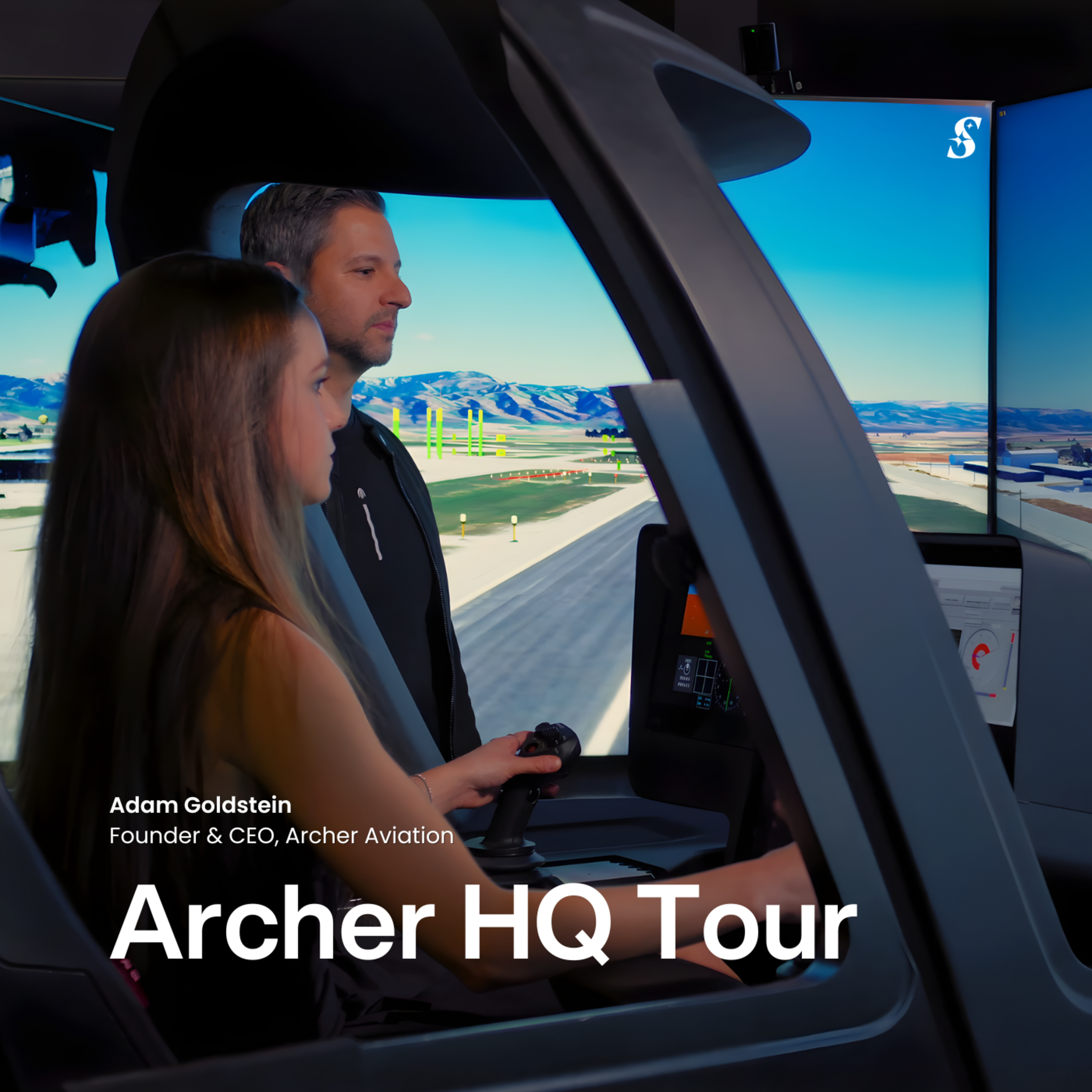
To overcome a major barrier to adoption, flying car company Archer is designing its eVTOLs to be compatible with existing helicopter infrastructure. By fitting within the size, weight, and flight plan constraints of current helipads, the company avoids the massive capital expenditure and regulatory hurdles of building a new network of "VertiPorts."

While electric air taxis are faster than cars, their key competitive advantage over helicopters is their low noise level. This allows them to operate in densely populated urban areas where noisy helicopters are banned, dramatically expanding the potential market for point-to-point air travel.

While helicopters offer similar short-hop travel in cities like New York, they are exceedingly loud, limiting where they can operate. Joby's electric flying machines are nearly silent, which is the game-changing feature that will enable widespread deployment in urban settings.

Joby recognized that noise, not just cost, limits helicopter scalability. They invested early in the fundamental physics of acoustics to create a quiet aircraft. This 'second-order' innovation is key to integrating their service into communities and achieving widespread adoption where helicopters have failed.
To secure a strategic foothold in the critical Los Angeles market, eVTOL company Archer Aviation purchased the Hawthorne private airport for ~$170 million. This gives them a base near LAX and SoFi Stadium, bordering Elon Musk's companies like SpaceX, creating a hub for the future of transportation.
