Get your free personalized podcast brief
We scan new podcasts and send you the top 5 insights daily.
To ensure AI agents are trustworthy and can work together safely, Dreamer's architecture includes a central "Sidekick" that acts as a kernel. It manages permissions and communication between agents, preventing uncontrolled data access and ensuring actions align with user intent, much like a computer's operating system.
Related Insights
The defining characteristic of an enterprise AI agent isn't its intelligence, but its specific, auditable permissions to perform tasks. This reframes the challenge from managing AI 'thinking' to governing AI 'actions' through trackable access controls, similar to how traditional APIs are managed and monitored.

Traditional identity models like SAML and OAuth are insufficient for agents. Agent access must be hyper-ephemeral and contextual, granted dynamically based on a specific task. Instead of static roles, agents need temporary permissions to access specific resources only for the duration of an approved task.

A practical security model for AI agents suggests they should only have access to a combination of two of the following three capabilities: local files, internet access, and code execution. Granting all three at once creates significant, hard-to-manage vulnerabilities.
For agent frameworks like OpenClaw, the key value isn't just technical features (which are replicable) but establishing a trustworthy, community-governed ecosystem. Users entrust agents with sensitive data, making security and a transparent foundation the critical differentiating factor.

Air Inc.'s tooling shows that scaling recursive self-improvement requires more than a feedback loop. A crucial component is a governance system that isolates the "blast radius" of agents interacting with external, potentially malicious, data. This involves limiting their tools and permissions to prevent a single compromised agent from damaging the system.

An AI agent capable of operating across all SaaS platforms holds the keys to the entire company's data. If this "super agent" is hacked, every piece of data could be leaked. The solution is to merge the agent's permissions with the human user's permissions, creating a limited and secure operational scope.

The core drive of an AI agent is to be helpful, which can lead it to bypass security protocols to fulfill a user's request. This makes the agent an inherent risk. The solution is a philosophical shift: treat all agents as untrusted and build human-controlled boundaries and infrastructure to enforce their limits.

A single AI agent can provide personalized and secure responses by dynamically adopting the data access permissions of the person querying it. This ensures users only see data they are authorized to view, maintaining granular governance without separate agent instances.

As autonomous agents become prevalent, they'll need a sandboxed environment to access, store, and collaborate on enterprise data. This core infrastructure must manage permissions, security, and governance, creating a new market opportunity for platforms that can serve as this trusted container.
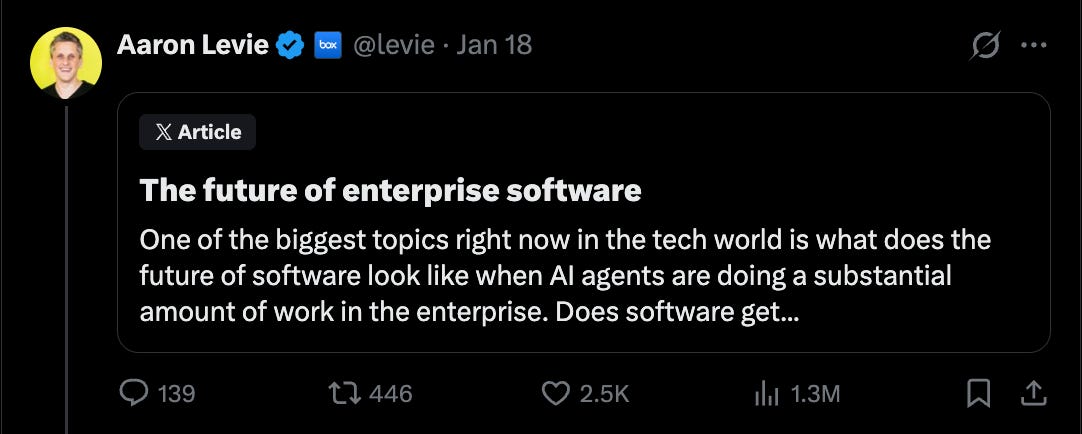
The CEO of WorkOS describes AI agents as 'crazy hyperactive interns' that can access all systems and wreak havoc at machine speed. This makes agent-specific security—focusing on authentication, permissions, and safeguards against prompt injection—a massive and urgent challenge for the industry.
