Get your free personalized podcast brief
We scan new podcasts and send you the top 5 insights daily.
Philosopher Nick Bostrom suggests that even if AI surpasses human intellect in fields like theoretical mathematics, it won't eliminate human engagement. Instead, these pursuits may evolve into hobbies appreciated for the process and social connection, much like chess has remained popular despite computer dominance.

Related Insights
Like chess players who still compete despite AI's dominance, humans will continue practicing skills like writing or design even when AI is better. The fear that AI will make human skill obsolete misses the point. The intrinsic motivation comes from the journey of improvement and the act of creation itself.

Former OpenAI scientist Andrej Karpathy posits that once AGI handles most cognitive tasks, education will shift from a professional necessity to a personal pursuit. Similar to how people visit gyms for health and enjoyment despite machines handling heavy labor, learning will become an optional activity for fulfillment.
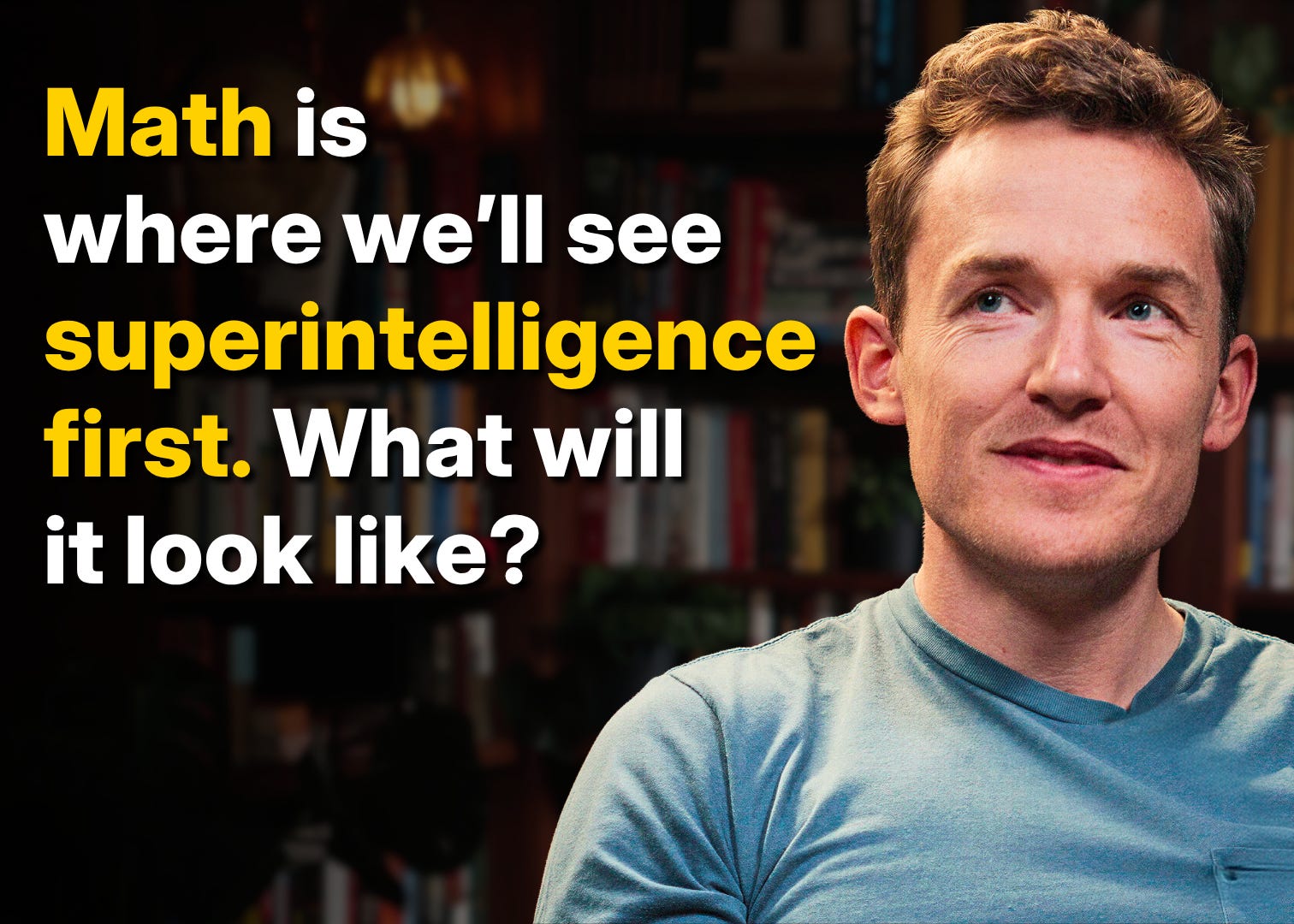
Top AI models are now solving major open problems in mathematics, leading some in the field to feel their core purpose is being automated away. This isn't just about tools; it's a profound identity crisis for a discipline built on human ingenuity and the pursuit of solving theorems.

Contrary to fears, AI surpassing human ability has fueled chess's popularity. AI engines are used as personalized coaches in products like Chess.com, analyzing games and helping millions of users learn and improve, making the game more accessible.

As AIs automate theorem proving and even explanation, the role of human mathematicians will shift. Instead of being creators, they will act as curators, using their taste and social connection to guide others through the vast, AI-generated landscape of mathematical ideas. Their value will lie in providing motivation and a human-centric narrative.
Drawing parallels to chess and Go, Demis Hassabis argues that AI's superiority doesn't kill human competition. Instead, it creates a new "knowledge pool" for humans to learn from. The current top Go player is stronger than any before him precisely because he grew up studying AlphaGo's strategies, suggesting AI tools will elevate, not replace, top human talent.

In a post-work world, sports and games like chess offer a durable source of meaning because they are based on artificially constructed scarcity and rules. Even with superhuman AIs, humans will continue to value human-vs-human competition, making these activities one of the few AI-proof jobs and sources of purpose.

Even if AI could instantly prove any mathematical claim, it wouldn't end the field. The truly creative and valuable work in mathematics lies in higher-level tasks AI can't do: asking interesting questions, identifying fruitful problems, and inventing entirely new branches of mathematics like calculus or information theory.
When computers surpassed humans at chess, many predicted the game's demise. Instead, AI tools became powerful coaches that helped players improve faster and understand the game more deeply, leading to a massive surge in popularity and more exciting human vs. human matches.

We perceive complex math as a pinnacle of intelligence, but for AI, it may be an easier problem than tasks we find trivial. Like chess, which computers mastered decades ago, solving major math problems might not signify human-level reasoning but rather that the domain is surprisingly susceptible to computational approaches.
