Get your free personalized podcast brief
We scan new podcasts and send you the top 5 insights daily.
Markets react sharply to clear, quantifiable events like tariff announcements but are poor early-warning signals for gradual, harder-to-price risks like the erosion of democratic norms. This creates a dangerous complacency among investors and policymakers.

Related Insights
While societal decline can be a long, slow process, it can unravel rapidly. The tipping point is when the outside world loses confidence in a nation's core institutions, such as its legal system or central bank. This triggers a sudden flight of capital, talent, and investment, drastically accelerating the collapse.

Conventional definitions of risk, like volatility, are flawed. True risk is an event you did not anticipate that forces you to abandon your strategy at a bad time. Foreseeable events, like a 50% market crash, are not risks but rather expected parts of the market cycle that a robust strategy should be built to withstand.
![[REPLAY] Morgan Housel – Same as Ever (EP.359) thumbnail](https://static.libsyn.com/p/assets/f/b/7/6/fb76e1c8bfb69e8dd959afa2a1bf1c87/CA_Square_logo_light_background_6.26.24.jpg)
Contrary to popular belief, the 1929 crash wasn't an instantaneous event. It took a full year for public confidence to erode and for the new reality to set in. This illustrates that markets can absorb financial shocks, but they cannot withstand a sustained, spiraling loss of confidence.
Extreme wealth inequality creates a fundamental risk beyond social unrest. When the most powerful citizens extricate themselves from public systems—schools, security, healthcare, transport—they lose empathy and any incentive to invest in the nation's core infrastructure. This decay of shared experience and investment leads to societal fragility.

Policies designed to suppress market volatility create a fragile stability. The underlying risk doesn't disappear; it transmutes into social and political polarization, driven by wealth inequality. This social unrest is a leading indicator of future market instability.

While tariffs were a dominant market concern previously, they have fallen in priority for investors. The primary focus has shifted to more systemic risks, including the potential for fiscal dominance over the Federal Reserve and the long-term trend of "de-dollarization" among global institutions.

Market participants are conditioned to expect a dramatic "Minsky moment." However, the more probable reality is a slow, grinding decline characterized by a decade of flat equity prices, compressing multiples, and degrading returns—a "death by a thousand cuts" rather than one catastrophic event.

Quoting G.K. Chesterton, Antti Ilmanen highlights that markets are "nearly reasonable, but not quite." This creates a trap for purely logical investors, as the market's perceived precision is obvious, but its underlying randomness is hidden. This underscores the need for deep humility when forecasting financial markets.
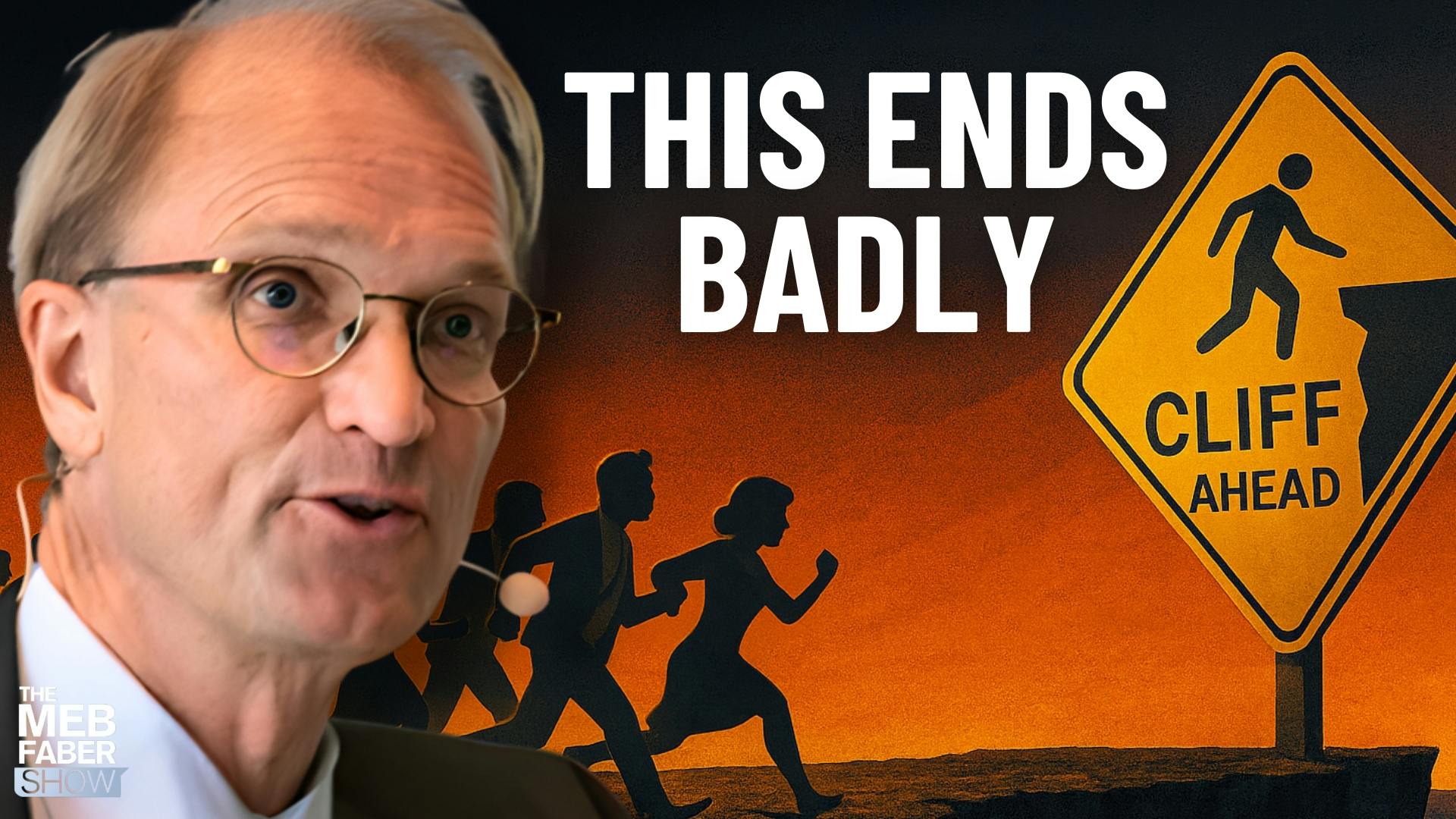
The underlying math of U.S. debt is unsustainable, but the system holds together on pure confidence. The final collapse won't be a slow leak but a sudden 'pop'—an overnight freeze when investors collectively stop believing the government can honor its debts, a point which cannot be timed.
The traditional relationship where economic performance dictated political outcomes has flipped. Now, political priorities like tariff policies, reshoring, and populist movements are the primary drivers of economic trends, creating a more unpredictable environment for investors.