Get your free personalized podcast brief
We scan new podcasts and send you the top 5 insights daily.
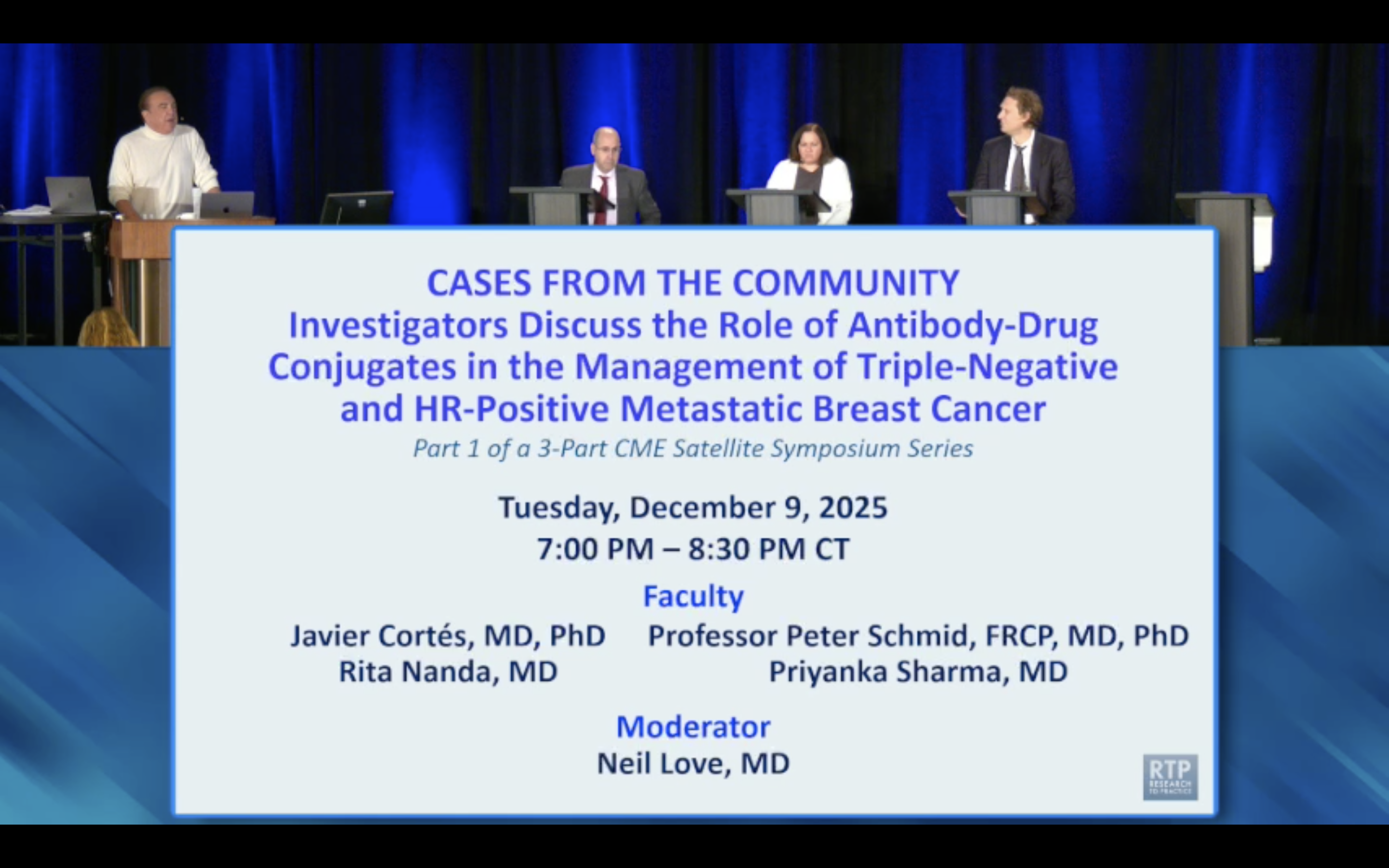
The Begonia trial showed an ~80% response rate by combining an ADC (Dato-DXD) with immunotherapy (Durvalumab) in first-line metastatic TNBC patients, 87% of whom were PD-L1 negative. This suggests ADCs, through immunogenic cell death, may create an immune-responsive environment, expanding IO benefit beyond the traditional biomarker.
Related Insights
The future of advanced prostate cancer treatment may involve combining ADCs with bispecific T-cell engagers. This strategy could use ADCs for a short duration to deliver a potent hit, followed by immunotherapy to achieve durable remission, potentially reducing toxicity and enabling earlier use.

In a future TNBC landscape with new antibody-drug conjugates (ADCs), Pumitamig is framed as a fundamentally different tool. The expert views ADCs as a form of "chemotherapy," while Pumitamig is an "immunotherapeutic strategy." This conceptual separation suggests a future where these novel agents are used in combination or sequence, not in direct competition.

In the Keynote 522 trial for early-stage TNBC, adding pembrolizumab to chemotherapy resulted in only a modest improvement in pathological complete response (pCR). Surprisingly, this small initial gain translated into much more robust and significant long-term improvements in event-free and overall survival.
Dr. Patrick Baeuerle suggests that instead of engineering complex co-stimulatory signals into T-cell engagers, a more effective strategy is to combine them with standard-of-care treatments like chemotherapy or ADCs. This approach dramatically augments efficacy and has already prompted multiple Phase 3 trials.

After standard immunotherapy biomarkers like PD-L1 and TMB proved ineffective in SCLC, the field shifted to a more direct approach. Novel therapies like the bispecific antibody tarlatumab target surface proteins such as DLL3, physically bridging immune cells to cancer cells without relying on predictive biomarkers.
The TROPION-PanTumor01 study showed that patients who progressed on the TROP2-ADC sacituzumab govitecan still achieved responses to a second TROP2-ADC, Dato-DXD. This suggests that targeting the same antigen with a different payload can overcome initial resistance, informing future treatment sequencing.
While immunotherapy was a massive leap forward, Dr. Saav Solanki states the next innovation frontier is combining it with newer modalities. Antibody-drug conjugates (ADCs) and T-cell engagers are being used to recruit the immune system into the tumor microenvironment, helping patients who don't respond to current immunotherapies.

In notoriously hard-to-treat small cell lung cancer (SCLC), ADCs are emerging as a crucial next step. They hold promise for patients who progress after chemoimmunotherapy and newer targeted agents like tarlatamab, a setting where treatment options are currently scarce. ADCs could provide meaningful responses in this significant unmet need.
The bispecific antibody Pumitamig demonstrated identical overall response rates in both PD-L1 positive and negative triple-negative breast cancer patients. This is significant as it provides a potential immunotherapy option for the two-thirds of patients who are PD-L1 negative and currently ineligible for such treatments.
Clinical trial data shows that despite specific toxicities, antibody-drug conjugates (ADCs) can be better tolerated overall than standard chemotherapy. For example, trials for both sacituzumab govitecan and dato-DXd reported fewer patients discontinuing treatment in the ADC arm compared to the chemotherapy arm.