Get your free personalized podcast brief
We scan new podcasts and send you the top 5 insights daily.
Research shows AI enhances productivity for everyone. While superstars become more effective, the most significant lift is for median performers, effectively raising the entire productivity floor. This suggests AI can act as a great equalizer of skill, not just a magnifier of existing talent.

Related Insights
While AI can raise the baseline for average performers, its most profound impact will be on "super-empowered individuals." The already great will use AI to achieve 10x productivity leaps, becoming "spectacularly great" in their fields.
An MIT study reveals AI's asymmetrical impact on productivity. While it moderately improves performance for average workers, it provides an exponential boost to the top 5%. This is because effectively harnessing AI is a skill in itself, leading to a widening gap between good and great.

Despite AI's power, even researchers at frontier labs report a median productivity boost of 2x. They emphasize that their complex AI systems would quickly drop to near-zero productivity if the human were completely removed, highlighting the continued necessity of "human salt" for meaningful work.

Contrary to popular belief, AI reduces inequality of output. Research shows that AI provides the biggest performance lift to lower-skilled workers, bringing their output closer to that of experts. This elevates the value of human judgment over rote implementation, narrowing the performance and wage gap between top and bottom performers.

AI is not a great equalizer; it's a productivity multiplier for those who are already highly skilled. A top-tier engineer or writer can double or triple their output, while an average performer sees smaller gains. This dynamic is set to exacerbate the K-shaped economy, making the rich richer and the poor comparatively poorer.

AI acts as a force multiplier for a company's best and most ambitious people, not a tool to make weak performers competent. It allows top talent to automate mundane work and focus on high-value strategy, effectively widening the performance gap between the most and least productive employees.

While AI will make average performers good, its most dramatic effect will be making great performers spectacularly great. By augmenting top talent in fields like coding, art, or science, AI enables a single individual to achieve productivity levels previously requiring large teams, creating a new class of hyper-achievers.

Artificial intelligence acts as a great equalizer by regressing everything to the mean. For those in the bottom 50% of any skill, AI provides a significant boost. However, for those in the top 50%, it can be a detriment, pulling their unique, high-quality work back toward a passable, average standard.

Rather than just benefiting specialists, AI provides the greatest leverage to generalists. It allows individuals to translate their knowledge work across different domains and artifacts—from writing a document to building an application—dramatically increasing their scope and impact without deep specialization in each area.
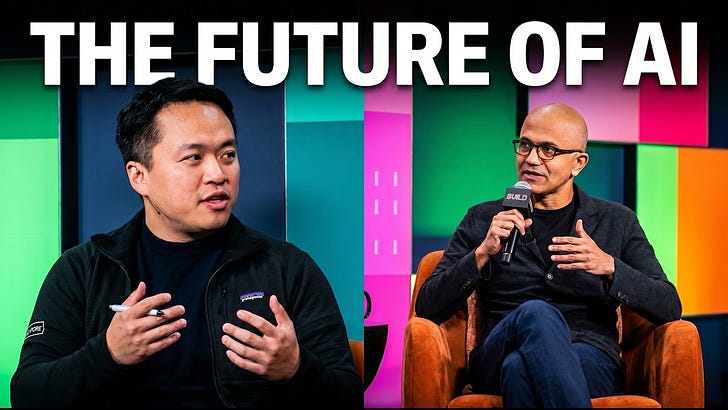
Just as search democratized information, AI will democratize intelligence. Instead of relying on the varied capabilities of many employees, AI copilots will elevate everyone's performance to the 95th percentile. This transforms the workforce model to a few experts directing many highly capable AI agents.