Get your free personalized podcast brief
We scan new podcasts and send you the top 5 insights daily.
Unlike the novel and abstract challenge of AI alignment, biosecurity threats are known problems. Solutions, like stockpiling PPE, are concrete and can be directly addressed with sufficient funding and execution, making it a more tractable domain for immediate impact.

Related Insights
Simple refusal mechanisms in AI models are easily bypassed by motivated actors. Effective biosecurity requires deeper interventions, such as curating training data to exclude sensitive biological information or implementing strict access controls for the most powerful models, ensuring they aren't publicly available.
Top AI labs and biotech firms are urging the US government to mandate screening for nucleic acid synthesis orders. This pragmatic approach targets a concrete threat—AI-assisted bioweapon creation—rather than abstract superintelligence risks.

Nick Bostrom argues AI-driven biological threats are more dangerous than cyber threats because defense mechanisms differ fundamentally. A cyber vulnerability can be patched almost instantly across all systems. A biological pathogen, however, requires a countermeasure like a vaccine that takes months to produce and distribute globally, giving the offense a massive advantage.

Mythos is a general-purpose system also proficient in biology. How society, governments, and companies manage the risks and norms of AI in cybersecurity is a direct preview of the much higher-stakes challenge of managing future AI-driven biological threats.

While the public debates data centers, the AI industry's internal anxiety has moved beyond job displacement. The focus is now on immediate security threats like AI-powered cyber weapons and potential bioweapons, along with alignment risks revealed by recent model security incidents.

There's a critical asymmetry in AI risk timelines. For cyber threats, an AI that finds an exploit can create a patch almost instantly. For biological threats, an AI might design a dangerous virus, but developing and deploying the corresponding countermeasure (e.g., a vaccine) takes far longer than the ~6 months before the virus-design capability diffuses to open-source models.
The danger of AI creating harmful proteins is not in the digital design but in its physical creation. A protein sequence on a computer is harmless. The critical control point is the gene synthesis process. Therefore, biosecurity efforts should focus on providing advanced screening tools to synthesis providers.

Existing bio-defense systems work by matching DNA sequences to known pathogen databases. However, generative AI can create novel sequences with different 'spellings' but the same dangerous function. Effective future defense must evolve to predict a sequence's function, not just its identity.
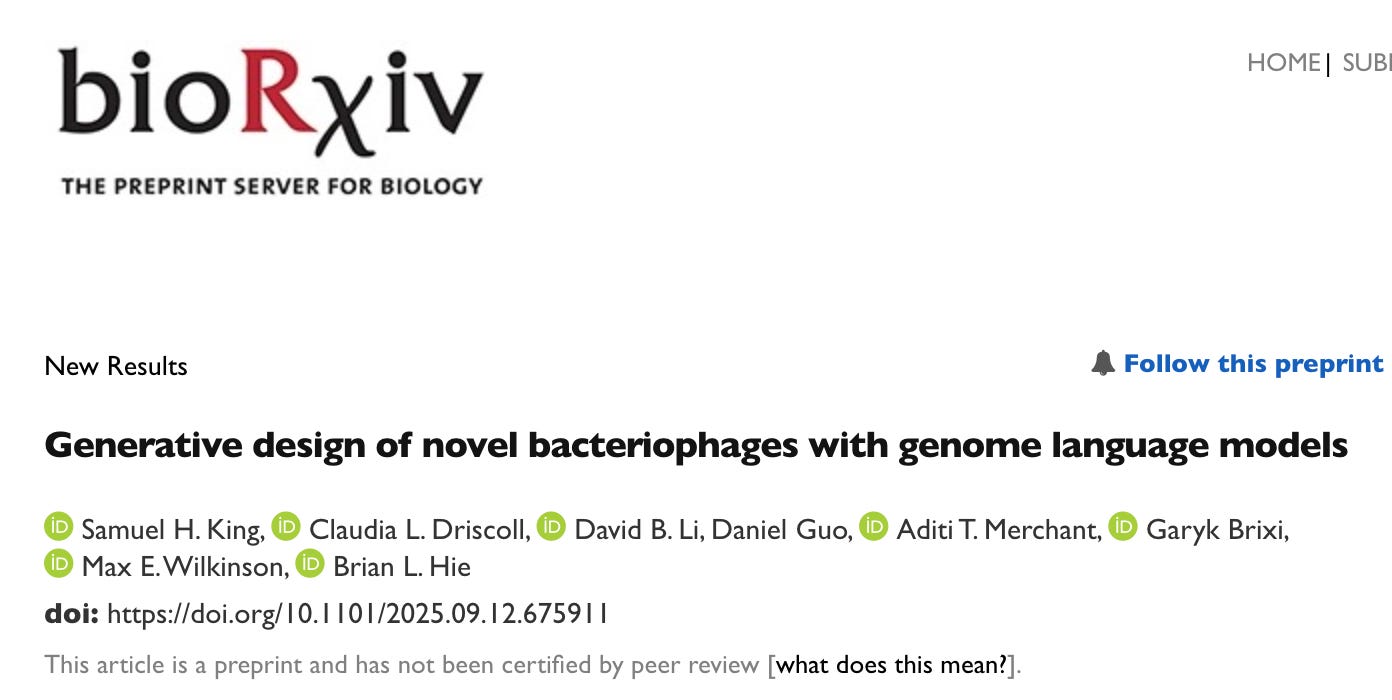
Valthos CEO Kathleen, a biodefense expert, warns that AI's primary threat in biology is asymmetry. It drastically reduces the cost and expertise required to engineer a pathogen. The primary concern is no longer just sophisticated state-sponsored programs but small groups of graduate students with lab access, massively expanding the threat landscape.

The focus on AGI can obscure more immediate threats. Even narrowly capable AI tools pose existential risks. For example, an AI that only excels at biotechnology research could make it easy for malicious actors to develop dangerous pathogens, regardless of its general intelligence.
