Get your free personalized podcast brief
We scan new podcasts and send you the top 5 insights daily.
In the TROPION-Breast02 trial, a survival benefit for Dato-DXD was seen mainly in regions without later-line access to TROP2 ADCs. Western patients often received an ADC second-line, muting the first-line survival difference and showing how post-progression therapy access can confound trial results.

Related Insights
The clinical strategy of 'saving' the most effective drugs for later lines of therapy may be flawed. Data indicates that 20-30% of patients with metastatic breast cancer do not go on to receive a subsequent line of treatment after progression, arguing for the use of optimal therapies like ADCs earlier in the disease course.

With half its patients from Asia and only 13% from North America, the Destiny Breast 11 trial's results may not be fully generalizable to US patients. Differences in metabolism, healthcare systems, and side effect reporting across regions can impact outcomes, a key consideration when interpreting global trial data.

In trials like ASCENT-4, where over 80% of the control arm received sacituzumab govitecan upon progression, the true overall survival (OS) benefit is obscured. This makes progression-free survival (PFS) a more reliable endpoint for evaluating the drug's first-line efficacy.
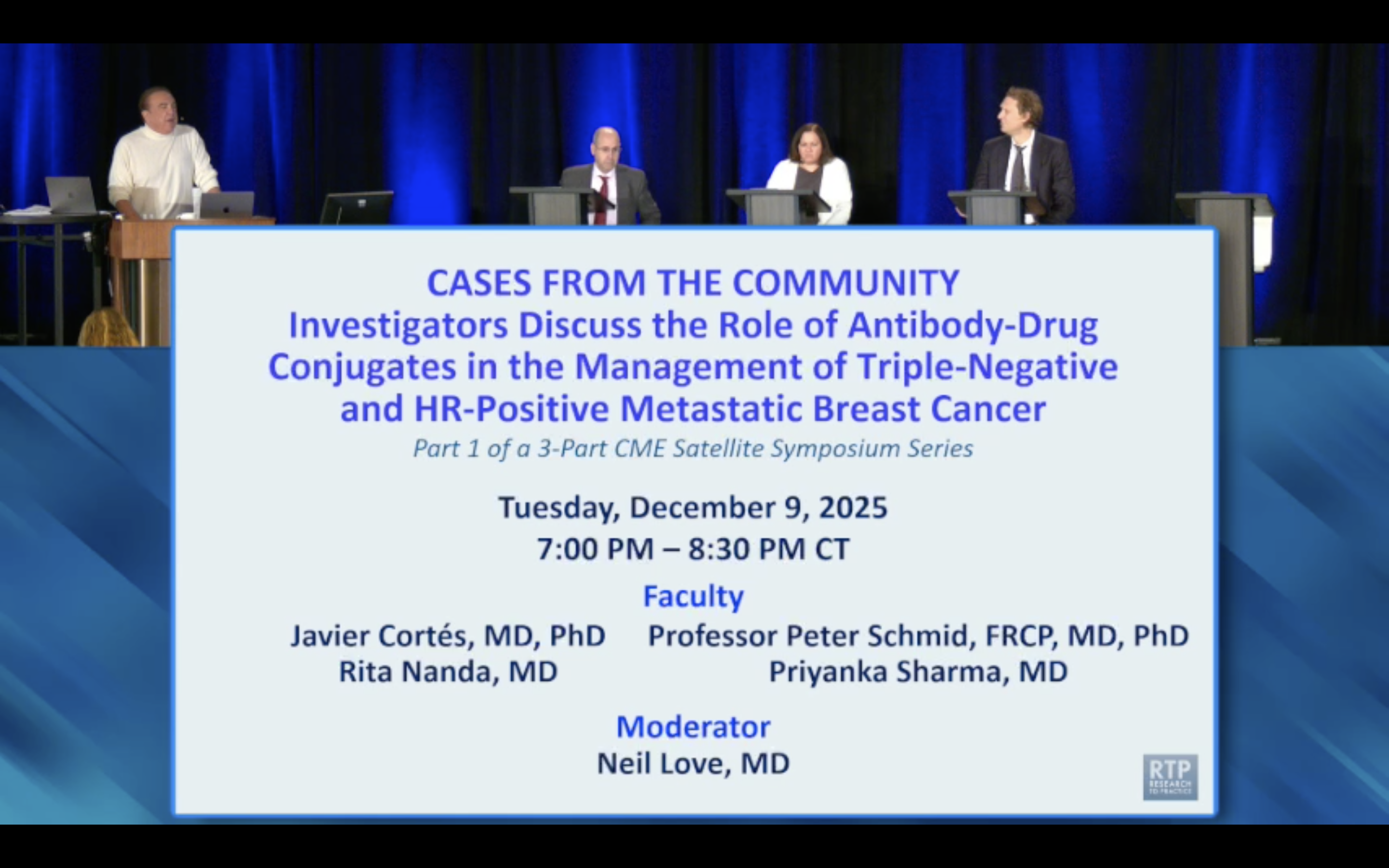
The global patient population in the pivotal DESTINY-Breast09 trial had less prior exposure to modern agents like pertuzumab and T-DM1 than is typical in Western clinics. This context is crucial when applying the trial's results to more heavily pre-treated populations.

In pivotal ADC trials like ASCENT-03 and 04, over 80% of patients in the control (chemotherapy) arm received the ADC upon progression. This high crossover rate makes interpreting overall survival (OS) data difficult, as the control group's outcomes are artificially improved by subsequent access to the novel drug.

In the ASCENT-07 trial, investigators may have prematurely switched patients from the standard chemotherapy arm to superior, commercially available ADCs at the first hint of progression. This real-world practice can mask an experimental drug's true benefit on progression-free survival.

An overall survival (OS) benefit in an adjuvant trial may not be meaningful for patients in systems (e.g., the U.S.) with guaranteed access to the same effective immunotherapy upon recurrence. The crucial, unanswered question is whether treating micrometastatic disease is inherently superior to treating macroscopic disease later, a distinction current trial data doesn't clarify.

The STARGLO trial (glofitamab-gemox) showed a strong survival benefit in Asia-Pacific patients but not in the small North American cohort. This geographic discrepancy, with only 9% of patients from the US, was a key reason the FDA did not approve the combination, while European agencies did.

When evaluating data like the impressive results from the SAC-TMT trial, clinicians must consider its geographic context. The study was conducted only in China, where trial outcomes are often more favorable than in broader global populations, warranting cautious optimism while awaiting global data.

The patient population in a global trial like DESTINY-Breast09 may not reflect typical Western practice. A significant portion of participants had no prior access to drugs like pertuzumab or T-DM1, making the trial their only path to advanced therapy. This context is crucial for interpreting results and generalizability.
