Get your free personalized podcast brief
We scan new podcasts and send you the top 5 insights daily.
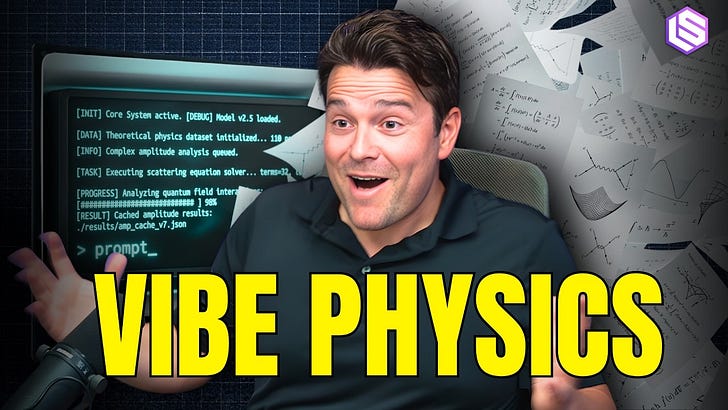
Instead of painstakingly charting a single research path, scientists now use AI to explore many potential directions simultaneously. By launching multiple chat instances, they can "scout" the problem space, quickly identifying promising avenues and discarding dead ends.
Related Insights
Frontier labs like OpenAI are now focused on building autonomous AI agents capable of conducting research and running experiments. This "auto researcher" is seen as the "final boss battle" to accelerate AI development itself.

AIs excel at exploring millions of problems at a surface level (breadth), a scale humans cannot match. Human experts provide the depth needed to tackle the difficult "islands" AIs identify. Science must shift from its current depth-focused model to one that first uses AI to map entire fields and clear away low-hanging fruit.
Instead of switching between ChatGPT, Claude, and others, a multi-agent workflow lets users prompt once to receive and compare outputs from several LLMs simultaneously. This consolidates the AI user experience, saving time and eliminating 'LLM ping pong' to find the best response.

Anthropic's new "Agent Teams" feature moves beyond the single-agent paradigm by enabling users to deploy multiple AIs that work in parallel, share findings, and challenge each other. This represents a new way of working with AI, focusing on the orchestration and coordination of AI teams rather than just prompting a single model.

Scientists constrained by limited grant funding often avoid risky but groundbreaking hypotheses. AI can change this by computationally generating and testing high-risk ideas, de-risking them enough for scientists to confidently pursue ambitious "home runs" that could transform their fields.

Instead of serial tasking, advanced users are becoming "agent jockeys," managing multiple AI instances simultaneously. Each agent performs a complex task in the background (e.g., ad generation, outreach), requiring the user to context-switch and manage a portfolio of automated workstreams to maximize output.
The evolution from AI autocomplete to chat is reaching its next phase: parallel agents. Replit's CEO Amjad Masad argues the next major productivity gain will come not from a single, better agent, but from environments where a developer manages tens of agents working simultaneously on different features.

The agent development process can be significantly sped up by running multiple tasks concurrently. While one agent is engineering a prompt, other processes can be simultaneously scraping websites for a RAG database and conducting deep research on separate platforms. This parallel workflow is key to building complex systems quickly.
Grok 4.20 uses "swarm intelligence," where multiple specialized AI agents collaborate and discuss problems before providing a solution. This approach, mirroring academic concepts, is now being commercialized to tackle more complex tasks than single models can handle.

AI research teams can explore multiple conversational paths simultaneously, altering variables like which agent speaks first or removing a 'critic' agent. This eliminates human biases like personality clashes or anchoring on the first idea, leading to more robust outcomes.
