Get your free personalized podcast brief
We scan new podcasts and send you the top 5 insights daily.
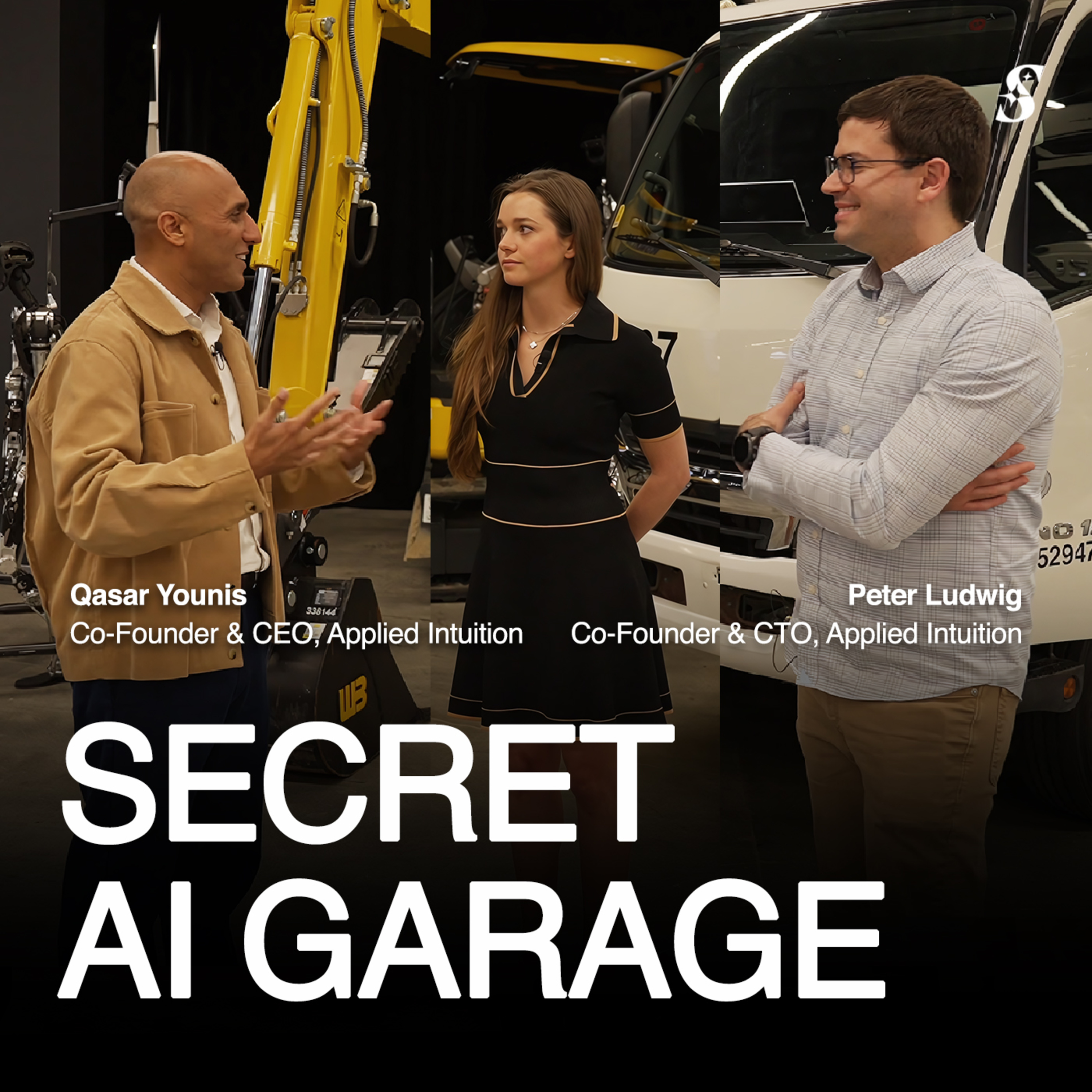
The next wave of innovation in physical AI will be unlocked by democratizing the tools. Applied Intuition's 'Dana' platform is designed to lower the barrier to entry, enabling students and entrepreneurs to create and deploy autonomous systems without needing specialized, arcane knowledge.

Related Insights
Applied Intuition uses the same fundamental software platform across cars, trucks, boats, and construction equipment. This is possible because all are machines interacting with the physical world governed by consistent laws of physics, enabling a scalable "Teslification" of multiple industrial sectors with a single core technology.
Much like early PCs made computing accessible beyond hobbyists, new platforms like Cursor SDK abstract away the complex engineering of AI agents. By providing a pre-built runtime, they empower non-coders to assemble and deploy sophisticated agents, dramatically expanding the pool of AI application creators.

For decades, hardware startups failed because building the necessary bespoke software was too difficult and expensive. The rise of general-purpose AI provides a powerful, adaptable software layer "out of the box." This dramatically lowers the barrier to scaling for hardware-intensive businesses like robotics and drones, making them more attractive for creative financing.

AI is democratizing software development by enabling non-technical subject-matter experts to build their own tools. By simply describing their ideas, they can generate fully deployed applications, shifting value from technical implementation to market and community insight.

Mirroring Google's Android strategy for mobile, Applied Intuition created a specialized OS to run AI across diverse hardware. This layer solves for safety-critical needs like real-time control, memory management, and reliable updates, which were previously impossible due to fragmentation across manufacturers.

The prohibitive cost of building physical AI is collapsing. Affordable, powerful GPUs and application-specific integrated circuits (ASICs) are enabling consumers and hobbyists to create sophisticated, task-specific robots at home, moving AI out of the cloud and into tangible, customizable consumer electronics.
Unlike pre-programmed industrial robots, "Physical AI" systems sense their environment, make intelligent choices, and receive live feedback. This paradigm shift, similar to Waymo's self-driving cars versus simple cruise control, allows for autonomous and adaptive scientific experimentation rather than just repetitive tasks.

By solving the core "intelligence" problem with a foundation model, the barrier to entry for creating novel robotic applications and form factors will dramatically decrease. This will enable a "Cambrian explosion" of hardware creativity, as builders will no longer need to solve AI from scratch for each new idea.
![Sergey Levine - Building LLMs for the Physical World - [Invest Like the Best, EP.465] thumbnail](https://megaphone.imgix.net/podcasts/fdcd4328-2c77-11f1-a72b-977309fd08f1/image/b1bb4368d6e13a4a804924681ffe3ab1.jpg?ixlib=rails-4.3.1&max-w=3000&max-h=3000&fit=crop&auto=format,compress)
Traditional vehicles have complex, disparate wiring and compute systems. Applied Intuition first simplifies this into a centralized "one box" architecture, which is a necessary step before they can effectively deploy advanced autonomy and AI capabilities, much like developing apps for a modern smartphone.
The combination of AI's reasoning ability and cloud-accessible autonomous labs will remove the physical barriers to scientific experimentation. Just as AWS enabled millions to become programmers without owning servers, this new paradigm will empower millions of 'citizen scientists' to pursue their own research ideas.
