Get your free personalized podcast brief
We scan new podcasts and send you the top 5 insights daily.
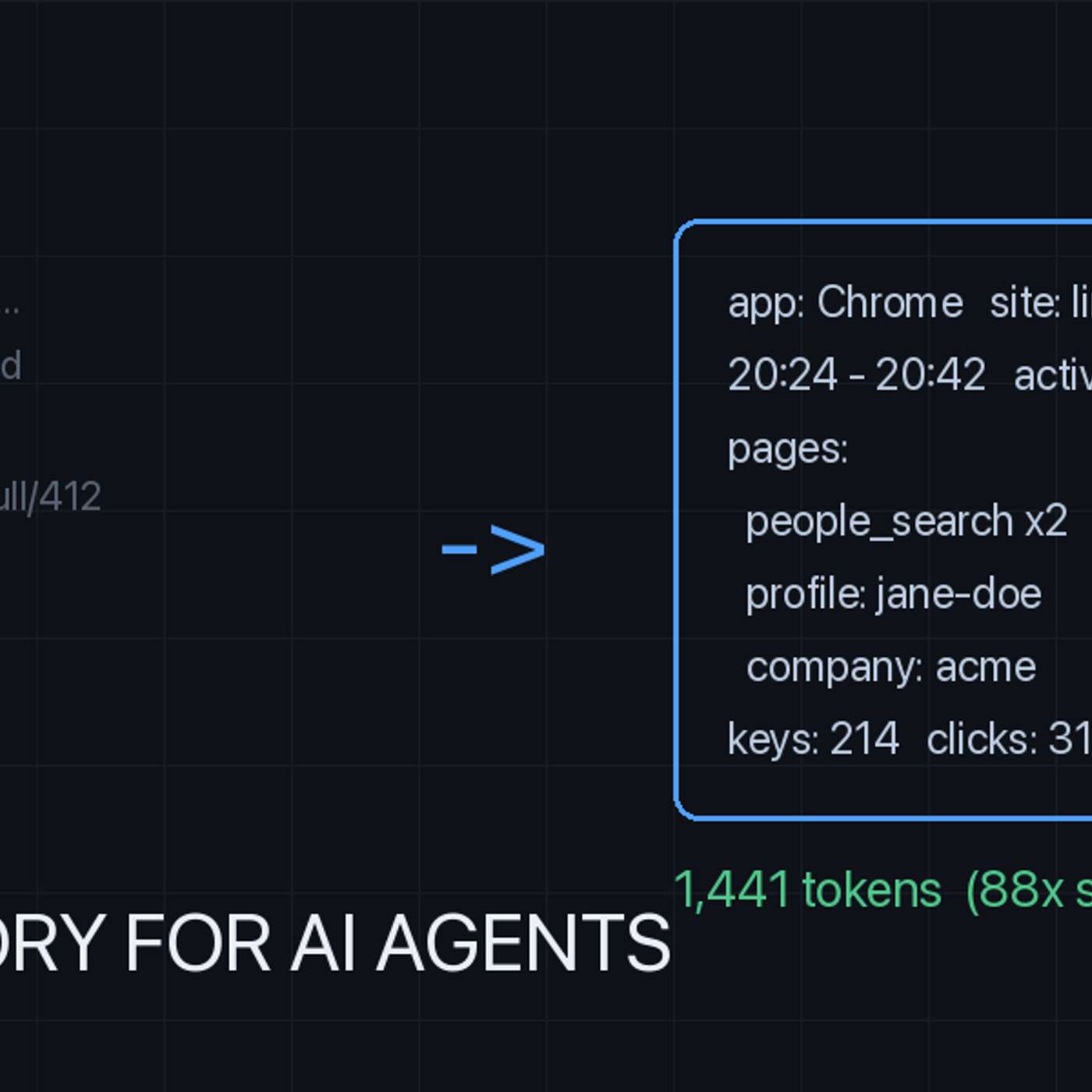
Current AI agents focus on "conversation memory" (what you tell them), completely missing the vast context of a user's actual work—like code commits, browsing sessions, or abandoned emails. This creates a significant blind spot in their understanding of user context and intent, as most work happens outside the chat window.
Related Insights
Current LLMs are intelligent enough for many tasks but fail because they lack access to complete context—emails, Slack messages, past data. The next step is building products that ingest this real-world context, making it available for the model to act upon.
![[State of RL/Reasoning] IMO/IOI Gold, OpenAI o3/GPT-5, and Cursor Composer — Ashvin Nair, Cursor thumbnail](https://assets.flightcast.com/V2Uploads/nvaja2542wefzb8rjg5f519m/01K4D8FB4MNA071BM5ZDSMH34N/square.jpg)
The most significant challenge holding back AI agent development is the lack of persistent memory. Builders dedicate substantial effort to creating elaborate workarounds for agents forgetting context between sessions, highlighting a critical infrastructure gap and a major opportunity for platform providers.
![Agent Building Trends [Operator Bonus Episode] thumbnail](https://d3t3ozftmdmh3i.cloudfront.net/staging/podcast_uploaded_nologo/41472609/41472609-1752234663609-8665756a468e5.jpg)
Implementing effective long-term memory for AI agents is a major unsolved problem. The difficulty is not in storing information, but in automatically generating useful memories from interactions and accurately retrieving the correct, context-specific memory without cluttering the prompt with irrelevant information.

While deep user history seems ideal for consumer AI, it can be a liability for professional work agents. The AI can get confused by irrelevant past projects, forcing the user to constantly curate its memory. This "context bleed" undermines productivity for multi-faceted knowledge work.
Current AI models are like the character in "50 First Dates"—they forget previous interactions. This "amnesia" is a key limitation. The next evolution of AI accelerators is integrating persistent memory to solve this, enabling agents to perform complex, stateful tasks and creating a huge market opportunity.

Long-running AI agents don't fail because the model is unintelligent. They fail because default memory management, like unmonitored append-only context windows, corrupts their state. This is a software engineering problem that requires an architectural solution, not better prompting or model tuning.

The primary barrier for useful AI agents is not the underlying model but the complex task of 'data wiring'—connecting to a user's real-world context like emails, local files, and support tickets. Products that solve this difficult integration challenge, where most agents currently fail, will gain a significant competitive advantage.
A key unsolved problem in frontier models is "coherence"—the inability to track what the user knows versus what the model knows. This causes them to produce outputs with inappropriate context or internal "thinking traces," creating a bottleneck for effective delegation and communication.

The "memory" feature in today's LLMs is a convenience that saves users from re-pasting context. It is far from human memory, which abstracts concepts and builds pattern recognition. The true unlock will be when AI develops intuitive judgment from past "experiences" and data, a much longer-term challenge.
![How Investors are using AI - [Business Breakdowns, EP.240] thumbnail](https://megaphone.imgix.net/podcasts/f879fb14-024c-11f1-9c47-7bea8da34fd0/image/56ffcbcc6e03475c408ac0e35a01510d.jpg?ixlib=rails-4.3.1&max-w=3000&max-h=3000&fit=crop&auto=format,compress)
An agent that ignores a user's preceding on-site behavior creates a frustrating experience by forcing them to waste time re-explaining their context. To be effective, agents must be fed the user's session data to start the conversation with informed, relevant suggestions or questions.
