Get your free personalized podcast brief
We scan new podcasts and send you the top 5 insights daily.
The innovation landscape for ER-positive metastatic breast cancer follows three parallel themes: 1) Developing superior endocrine agents like oral SERDs, 2) Advancing combination therapies with novel inhibitors (PI3K, mTOR, AKT), and 3) Creating new antibody-drug conjugates (ADCs) for patients who have become endocrine-resistant and would otherwise receive chemotherapy.

Related Insights
A novel strategy involves combining antibody-drug conjugates (ADCs) with PARP inhibitors. This approach could potentially overcome the need for a germline BRCA mutation, significantly broadening the patient population that could benefit from PARP inhibitor therapy in triple-negative breast cancer.
Cancers with estrogen receptor (ER) expression of 50% or less, while technically HR+, often behave biologically like basal or triple-negative tumors. These cancers are not primarily endocrine-driven and show a significant benefit from the addition of immune checkpoint inhibitors, challenging traditional subtype classifications.
The INOVO-123 trial strategically investigates a PI3K inhibitor-based triplet therapy for endocrine-sensitive, PIK3CA-mutated breast cancer. This moves beyond its current approval in the endocrine-resistant setting, aiming to establish its efficacy for patients with de novo metastatic disease or as a first-line treatment, thereby widening its use much earlier in the patient journey.
In metastatic breast cancer, approximately one-third of patients are unable to proceed to a second line of therapy due to disease progression or declining performance status. This high attrition rate argues for using the most effective agents, such as ADCs, in the first-line setting.
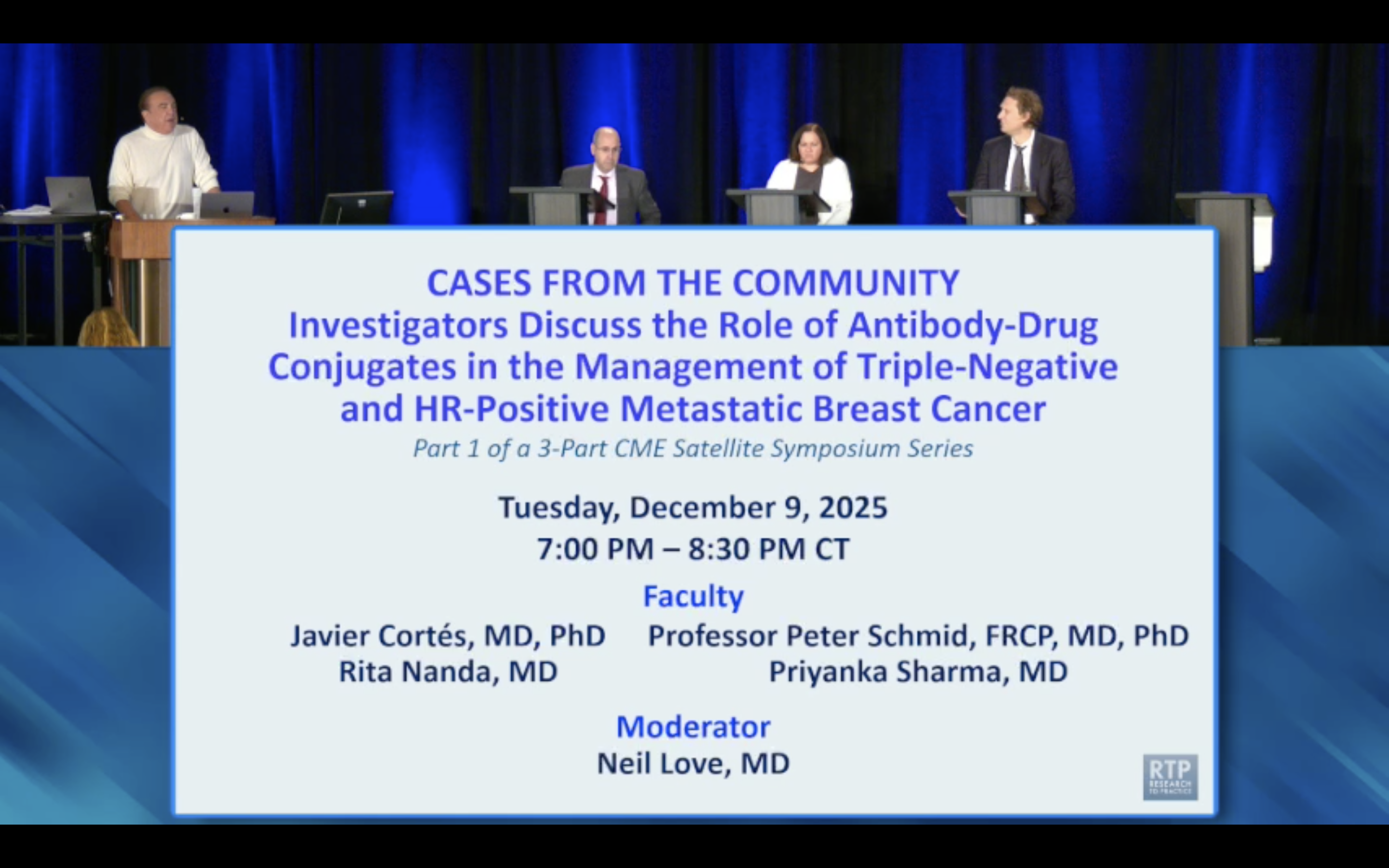
Rather than moving through distinct lines of therapy, a future strategy could involve an "ADC switch." When a patient progresses on an ADC-IO combination, the IO backbone would remain while the ADC is swapped for one with a different, non-cross-resistant mechanism, adapting the treatment in real-time.

Three major trials (RIGHT Choice, PADMA, OMBRE) definitively show that starting with a CDK4/6 inhibitor plus endocrine therapy is superior to upfront chemotherapy for newly diagnosed, symptomatic metastatic breast cancer. This approach provides better progression-free survival without the toxicity of chemotherapy and, critically, does not result in a slower time to response.
While immunotherapy was a massive leap forward, Dr. Saav Solanki states the next innovation frontier is combining it with newer modalities. Antibody-drug conjugates (ADCs) and T-cell engagers are being used to recruit the immune system into the tumor microenvironment, helping patients who don't respond to current immunotherapies.

As multiple effective Antibody-Drug Conjugates (ADCs) become available, the primary clinical challenge is no longer *if* they work, but *how* to use them best. Key unanswered questions involve optimal sequencing, dosing for treatment versus maintenance, and overall length of therapy, mirroring issues already seen in breast cancer.
The Phase 3 Ladera study found gerodestrin not only reduced the risk of recurrence by 30% over standard endocrine therapy but also caused fewer treatment discontinuations due to side effects. This dual benefit of superior efficacy and improved tolerability represents a significant potential advancement for patients with ER-positive early breast cancer.
Using a second CDK4/6 inhibitor after progression on a first showed disappointing results in trials like post-MONARCH. However, the EMBER-3 trial's success, combining abemaciclib with the novel SERD imlunestrant, demonstrated robust efficacy. This suggests the choice of endocrine partner is the critical factor for making this sequencing strategy viable.
