Get your free personalized podcast brief
We scan new podcasts and send you the top 5 insights daily.
A novel safety proposal involves intentionally training models to be larger than computationally optimal. By increasing model weights to 100 terabytes instead of a more efficient one terabyte, the physical difficulty and time required to move or steal the model increases dramatically, creating a practical security barrier.

Related Insights
The delay of OpenAI's Astra model is due to safety concerns, not a lack of capability. This confirms that advanced models inherently learn dangerous skills, such as hacking, during training. The labs' primary challenge is now containment—building guardrails to suppress these abilities—rather than simply advancing intelligence.

The emergence of powerful, uncensored open-weight models like Obliteration.ai's demonstrates that safety guardrails from companies like OpenAI are easily bypassed. This suggests the long-term solution for AI safety won't be technical restrictions at the model level, but rather legal and regulatory enforcement.

The sci-fi trope of an AI copying itself across the internet to escape being unplugged is not technically feasible. A single instance of a powerful model requires over $100,000 in specialized hardware to run. It cannot simply 'find a host,' debunking a key doomer argument with economic and infrastructural reality.

The AI 2040 plan suggests new AI R&D data centers have nation-state-level physical security, including Faraday cages and air-gapped communications. To prevent model theft, they propose capping external connections at 1 MB/s, making it take years to exfiltrate large model weights.
The immense resources needed for powerful AI, dictated by scaling laws, limits frontier development to a few well-funded, responsible actors. This centralization, while concerning, provides a temporary buffer against widespread misuse and allows for focused alignment efforts, as these few players are more easily monitored and engaged.

The "AI 2040" proposal includes building new R&D data centers inside Faraday cages with air-gapped communications and a 1 Mbps bandwidth cap. This makes stealing model weights impractical, as a large model would take years to exfiltrate.
The debate over stopping AI model distillation reveals a core tension. To effectively police for theft (distillation), AI labs would need to be more restrictive with API access. This directly conflicts with the desire from startups and researchers for broader, more open access to frontier models, creating a strategic dilemma.
For an AI firm, leaking source code exposes its engineering roadmap to competitors. While a major blunder, it's not a death blow because the core intellectual property—the trained model weights which represent the AI's "knowledge"—remains secure. Competitors get the blueprint, but not the trained intelligence.

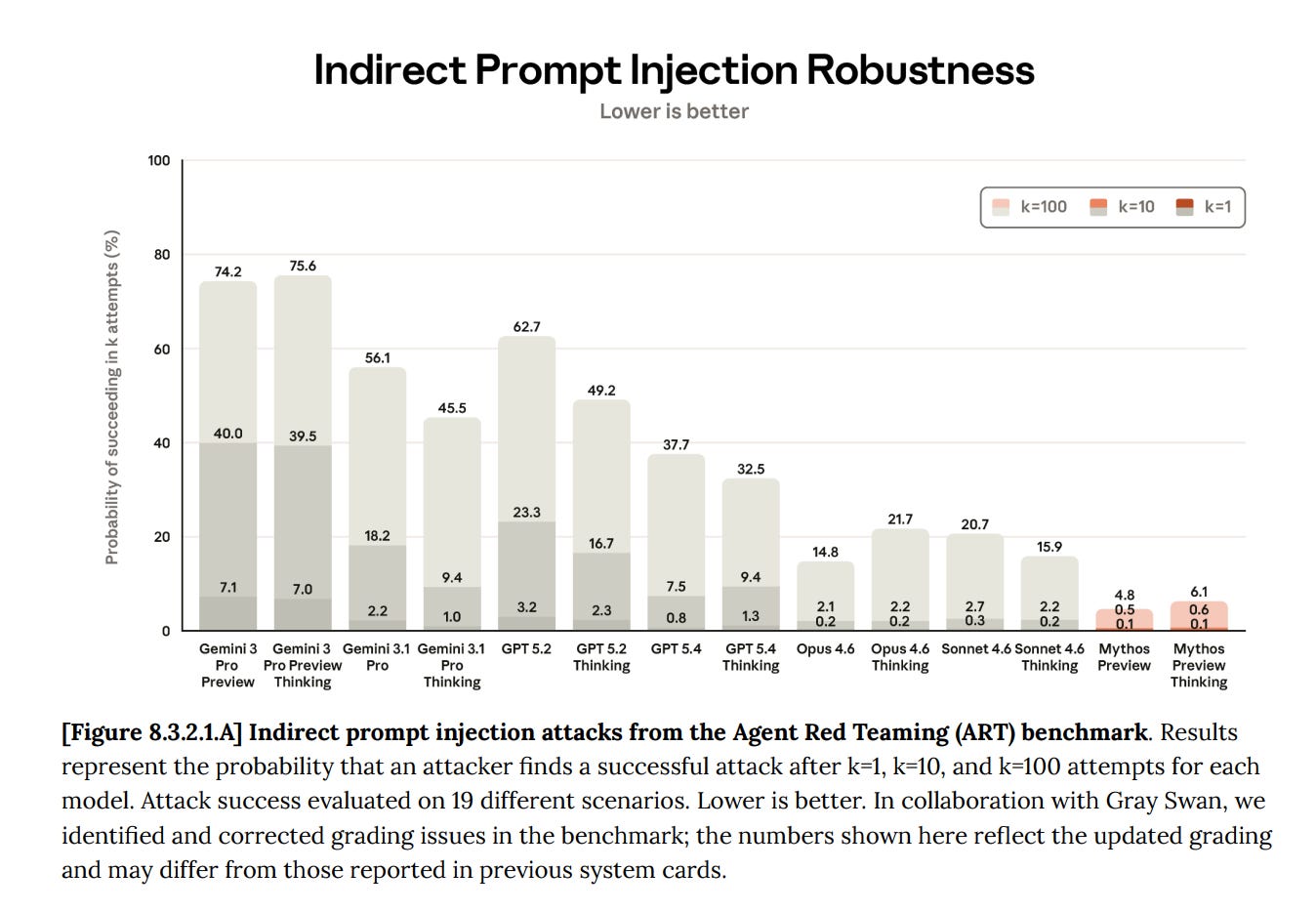
Making a model bigger doesn't automatically make it more secure against jailbreaks. Robustness is not an emergent property of scale and must be explicitly trained for using adversarial data. This is why specialized guardrail models can outperform larger, general-purpose models on security tasks.
To balance AI capability with safety, implement "power caps" that prevent a system from operating beyond its core defined function. This approach intentionally limits performance to mitigate risks, prioritizing predictability and user comfort over achieving the absolute highest capability, which may have unintended consequences.