Get your free personalized podcast brief
We scan new podcasts and send you the top 5 insights daily.
A "universal jailbreak" isn't a master key that works for all malicious tasks. Instead, it reliably bypasses safeguards for a specific category of harm, like cyberattacks or developing explosives. A jailbreak effective for cyberattacks won't necessarily work for bioweapons.

Related Insights
While retraining a core model is slow, developers can rapidly update external safeguards and filters. This creates a dynamic where a newly discovered jailbreak is like a zero-day exploit: it can be used for a short period before it's detected and patched, burning the exploit and making it useless.
The government's demand to 'patch' Fable's jailbreak misunderstands its core functionality. The model was designed for cyber defense, refusing to review insecure code but generating patches when asked to fix bugs—a feature, not a flaw. This highlights the deep technical gap between regulators and AI labs.

Using a powerful frontier model for automated red teaming is ineffective. Its built-in safety mechanisms cause it to refuse to generate the jailbreaks or attacks it's tasked with creating. Effective automated red teaming requires models specifically trained for adversarial purposes, often without the same safeguards.
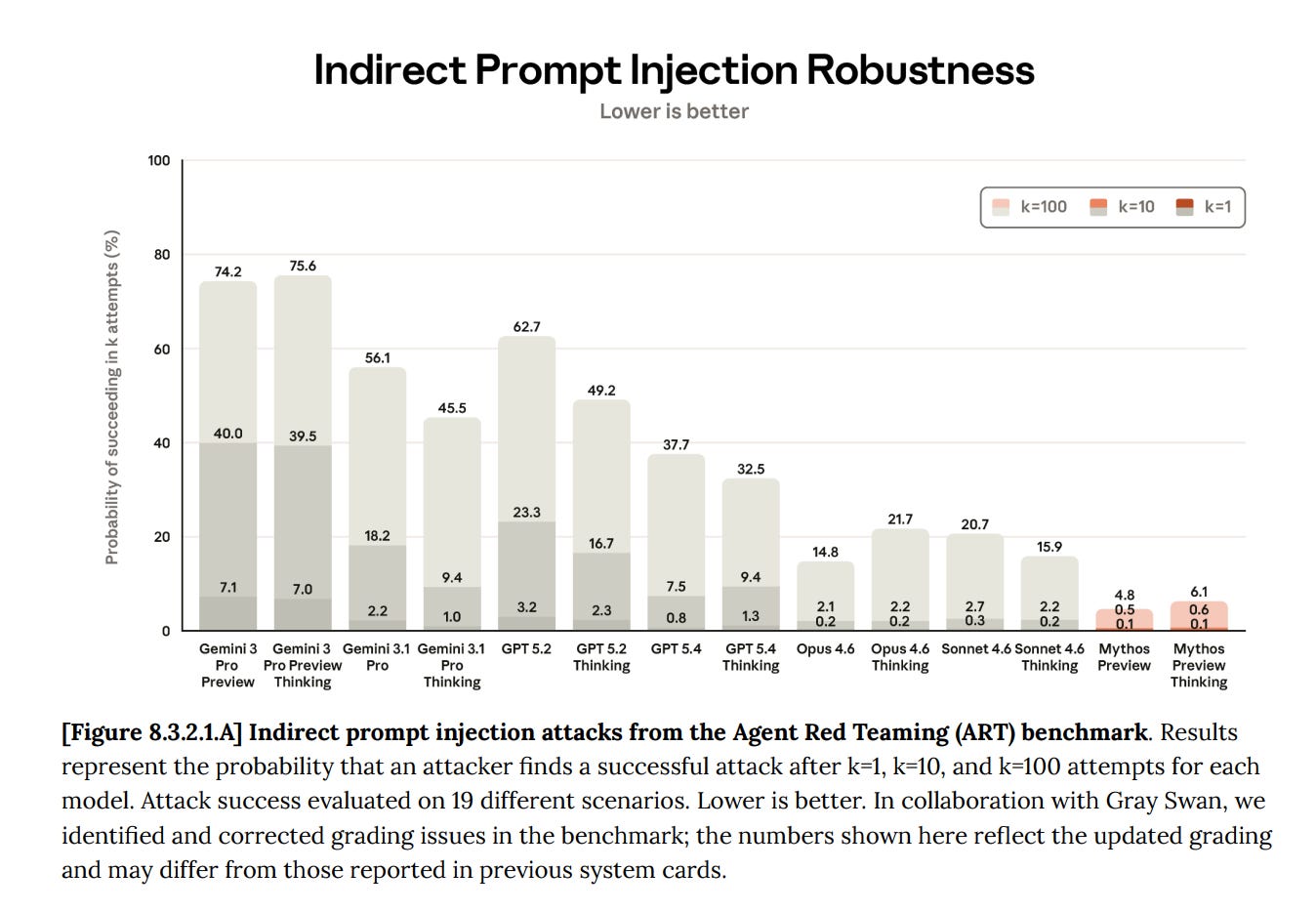
Anthropic admits perfect model safety is currently unachievable. Like software bugs, undiscovered "zero-day" jailbreaks that bypass all safeguards are an expected and constant threat, creating a continuous cat-and-mouse game between developers and malicious actors.

Advanced jailbreaking involves intentionally disrupting the model's expected input patterns. Using unusual dividers or "out-of-distribution" tokens can "discombobulate the token stream," causing the model to reset its internal state. This creates an opening to bypass safety training and guardrails that rely on standard conversational patterns.

Making a model bigger doesn't automatically make it more secure against jailbreaks. Robustness is not an emergent property of scale and must be explicitly trained for using adversarial data. This is why specialized guardrail models can outperform larger, general-purpose models on security tasks.
Current AI safety solutions primarily act as external filters, analyzing prompts and responses. This "black box" approach is ineffective against jailbreaks and adversarial attacks that manipulate the model's internal workings to generate malicious output from seemingly benign inputs, much like a building's gate security can't stop a resident from causing harm inside.

Hackers are exploiting AI models not just to write malicious code, but by circumventing safety protocols to extract sensitive or useful information embedded within the AI's training data. This represents a novel attack surface.

Jailbreaking is a direct attack where a user tricks a base AI model. Prompt injection is more nuanced; it's an attack on an AI-powered *application*, where a malicious user gets the AI to ignore the developer's original system prompt and follow new, harmful instructions instead.

Despite frontier model developers' efforts to harden their systems, the UK's AI Safety Institute reports its expert red team has never failed to jailbreak a model. While it is getting harder, this 100% success rate highlights the persistent vulnerability of current AI safeguards.