Get your free personalized podcast brief
We scan new podcasts and send you the top 5 insights daily.
The US focus on exporting hardware (chips, data centers) over proprietary models suggests a strategic belief that open-source AI will eventually dominate. If models become a free commodity, the most valuable and defensible part of the AI stack becomes the underlying compute infrastructure.

Related Insights
The White House's Michael Kratsios reframes "AI sovereignty" as owning American-built hardware and infrastructure, not renting access to US cloud models. This strategy encourages partner nations to buy the AI stack ("They build it. It's yours.") rather than remaining dependent on subscriptions.
By releasing powerful, open-source AI models, China may be strategically commoditizing software. This undermines the primary advantage of US tech giants like Microsoft and Google, while bolstering China's own dominance in hardware manufacturing and robotics.

By limiting access to top-tier proprietary models, U.S. policy may have ironically forced China to develop more efficient, open-source alternatives. This strategy is more effective for global adoption, as other countries can freely adapt these models without API limits or vendor lock-in.

Counterintuitively, China leads in open-source AI models as a deliberate strategy. This approach allows them to attract global developer talent to accelerate their progress. It also serves to commoditize software, which complements their national strength in hardware manufacturing, a classic competitive tactic.

A nation's advantage is its "intelligent capital stock": its total GPU compute power multiplied by the quality of its AI models. This explains the US restricting GPU sales to China, which counters by excelling in open-source models to close the gap.

Selling semiconductor equipment allows China to create hundreds of billions in downstream value. In contrast, selling API access to US models is a higher-margin strategy that keeps core value creation within the American ecosystem, extracting more revenue per unit of capability provided.
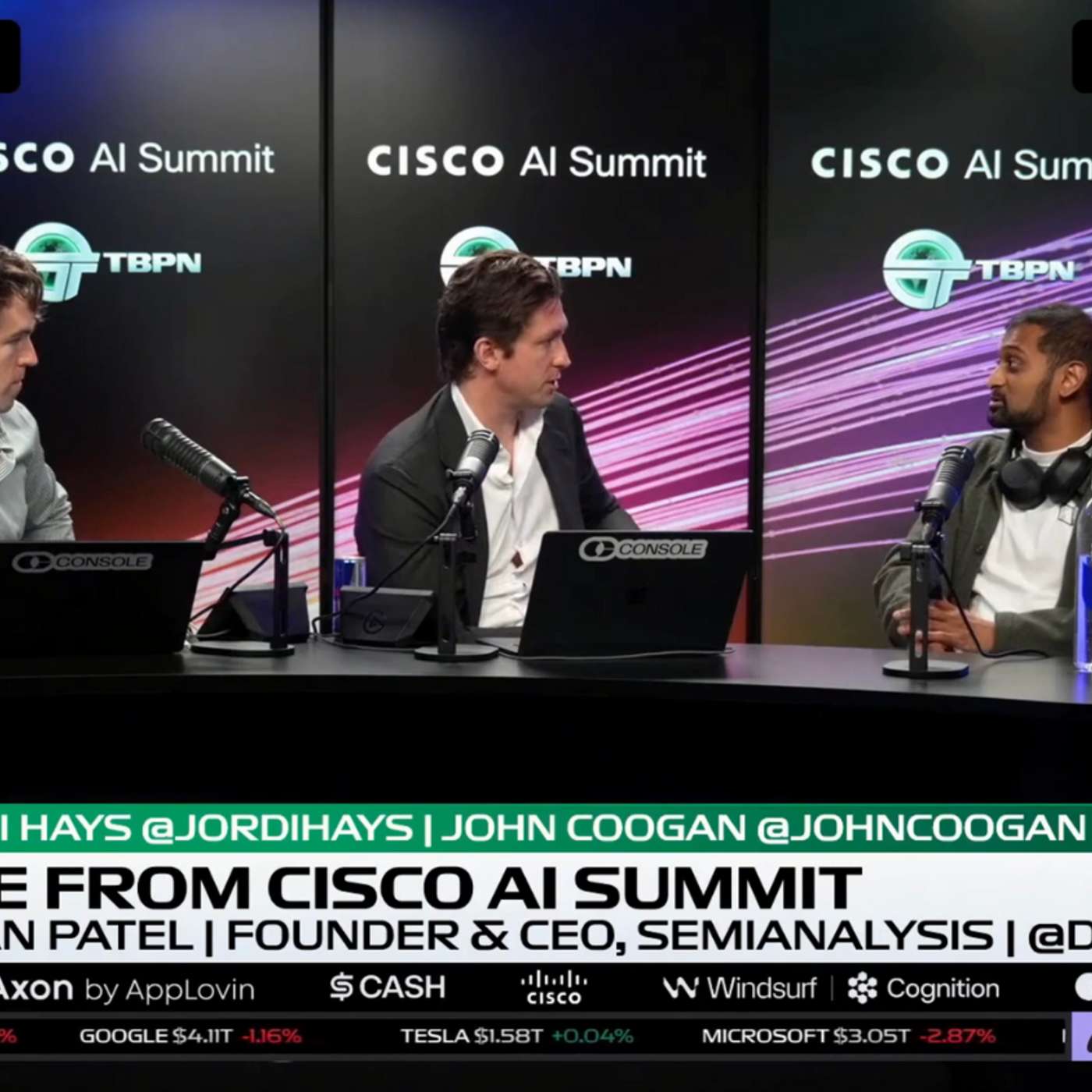
The US and China have divergent AI strategies. The US is pouring capital into massive compute clusters to build dominant global platforms like ChatGPT (aggregation theory). China is focusing its capital on building a self-sufficient, domestic semiconductor and AI supply chain to ensure technological independence.
![Dylan Patel - Inside the Trillion-Dollar AI Buildout - [Invest Like the Best, EP.442] thumbnail](https://megaphone.imgix.net/podcasts/799253cc-9de9-11f0-8661-ab7b8e3cb4c1/image/d41d3a6f422989dc957ef10da7ad4551.jpg?ixlib=rails-4.3.1&max-w=3000&max-h=3000&fit=crop&auto=format,compress)
Instead of military action, China could destabilize the US tech economy by releasing high-quality, open-source AI models and chips for free. This would destroy the profitability and trillion-dollar valuations of American AI companies.

The AI competition is not a simple two-horse race between the US and China. It's a complex 2x2 matrix: US vs. China and Open Source vs. Closed Source. China is aggressively pursuing an open-source strategy, creating a new competitive dynamic that complicates the landscape and challenges the dominance of proprietary US labs.

The open vs. closed source debate is a matter of strategic control. As AI becomes as critical as electricity, enterprises and nations will use open source models to avoid dependency on a single vendor who could throttle or cut off their "intelligence supply," thereby ensuring operational and geopolitical sovereignty.
