Get your free personalized podcast brief
We scan new podcasts and send you the top 5 insights daily.
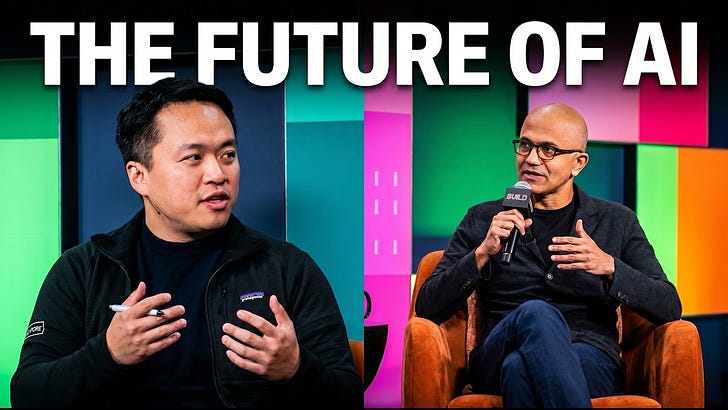
The most exciting application of AI isn't making people faster at their current jobs. It's enabling them to broaden their span of influence—like a backend engineer doing frontend work or a non-engineer automating technical customer onboarding—which creates significantly more business value.

Related Insights
The most potent productivity gains from AI aren't just for junior staff. Seasoned professionals who combine deep domain expertise with adaptability are using AI to rapidly learn adjacent skills like design or marketing. This allows them to "collapse the skill stack" and single-handedly perform tasks that previously required multiple people.

The common fear of AI eliminating jobs is misguided. In practice, AI automates specific, often administrative, tasks within a role. This allows human workers to offload minutiae and focus on uniquely human skills like relationship building and strategic thinking, ultimately increasing their leverage and value.

Frame internal AI initiatives not as a way to replace employees, but to automate their chores. This frees them to move 'up the stack' to perform higher-value functions like client relations, creative strategy, and founder meetings, ultimately increasing overall output.
Contrary to the popular belief that AI's main purpose is to replace humans for less money, user data shows its primary benefit is enabling entirely new functions. As AI costs rise, the focus will shift from simple cost-cutting to strategic investments in capabilities that were previously impossible.

AI acts as a force multiplier for a company's best and most ambitious people, not a tool to make weak performers competent. It allows top talent to automate mundane work and focus on high-value strategy, effectively widening the performance gap between the most and least productive employees.

Most view AI for efficiency, but its true power lies in handling routine tasks to free up human talent. This unlocks capacity for strategic, creative, and relationship-driven work that fuels innovation and growth, shifting the question from cost savings to new capabilities.

The most significant value from AI is not in automating existing tasks, but in performing work that was previously too costly or complex for an organization to attempt. This creates entirely new capabilities, like analyzing every single purchase order for hidden patterns, thereby unlocking new enterprise value.

AI does more than speed up existing work. It unbundles traditional workflows, jobs, and organizations, allowing for fundamentally new structures to emerge. The real value is in this "reshuffle," not in simple efficiency gains on today's work.

Initial AI productivity gains (e.g., turning a 2-day task into 10 minutes) are just the start. The true, transformative value emerges when business experts, newly empowered by AI thinking, use that saved time to pursue entirely new, previously impossible work, fundamentally changing business outcomes.
Rather than just benefiting specialists, AI provides the greatest leverage to generalists. It allows individuals to translate their knowledge work across different domains and artifacts—from writing a document to building an application—dramatically increasing their scope and impact without deep specialization in each area.