Get your free personalized podcast brief
We scan new podcasts and send you the top 5 insights daily.
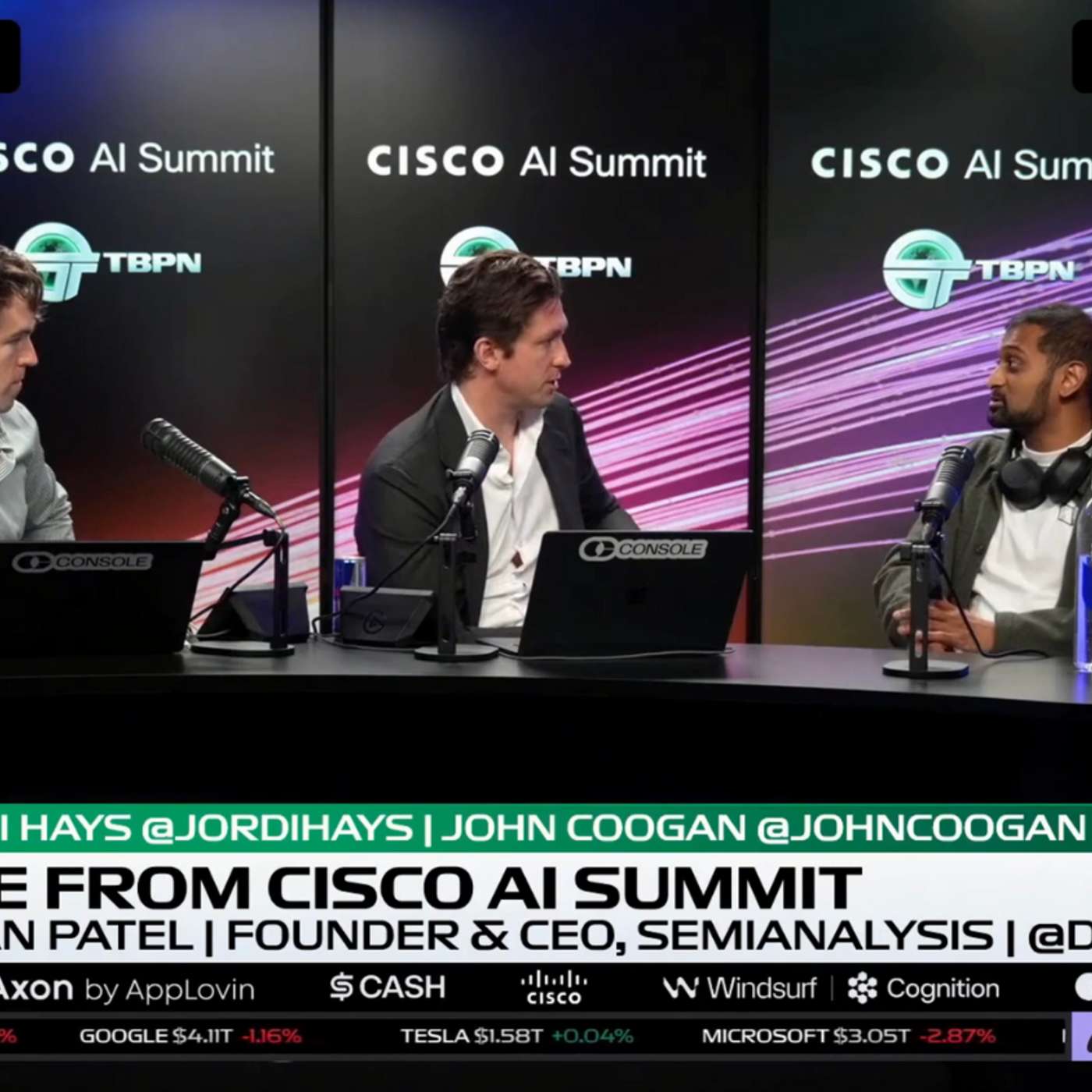
NVIDIA is moving from its 'one GPU for everything' strategy to a diversified portfolio. By acquiring companies like Grok and developing specialized chips (e.g., CPX for pre-fill), it's hedging against the unpredictable evolution of AI models by covering multiple points on the performance curve.
Related Insights
The AI inference process involves two distinct phases: "prefill" (reading the prompt, which is compute-bound) and "decode" (writing the response, which is memory-bound). NVIDIA GPUs excel at prefill, while companies like Grok optimize for decode. The Grok-NVIDIA deal signals a future of specialized, complementary hardware rather than one-size-fits-all chips.
While competitors chased cutting-edge physics, AI chip company Groq used a more conservative process technology but loaded its chip with on-die memory (SRAM). This seemingly less advanced but different architectural choice proved perfectly suited for the "decode" phase of AI inference, a critical bottleneck that led to its licensing deal with NVIDIA.
Nvidia paid $20 billion for a non-exclusive license from chip startup Groq. This massive price for a non-acquisition signals Nvidia perceived Groq's inference-specialized chip as a significant future competitor in the post-training AI market. The deal neutralizes a threat while absorbing key technology and talent for the next industry battleground.

Google is abandoning its single-line TPU strategy, now working with both Broadcom and MediaTek on different, specialized TPU designs. This reflects an industry-wide realization that no single chip can be optimal for the diverse and rapidly evolving landscape of AI tasks.
Nvidia's non-traditional $20 billion deal with chip startup Groq is structured to acquire key talent and IP for AI inference (running models) without regulatory hurdles. This move aims to solidify Nvidia's market dominance beyond chip training.

NVIDIA's commitment to programmable GPUs over fixed-function ASICs (like a "transformer chip") is a strategic bet on rapid AI innovation. Since models are evolving so quickly (e.g., hybrid SSM-transformers), a flexible architecture is necessary to capture future algorithmic breakthroughs.

Nvidia bought Grok not just for its chips, but for its specialized SRAM architecture. This technology excels at low-latency inference, a segment where users are now willing to pay a premium for speed. This strategic purchase diversifies Nvidia's portfolio to capture the emerging, high-value market of agentic reasoning workloads.

Despite NVIDIA's new Rubin chip boasting 10x inference improvements, the acquisition of Grok's team was not redundant. It was a strategic move to acquire a world-class team with rare expertise in SRAM innovation—a skill set outside NVIDIA's core wheelhouse—effectively a $20 billion acqui-hire for unique talent.
NVIDIA's deal with inference chip maker Grok is not just about acquiring technology. By enabling cheaper, faster inference, NVIDIA stimulates massive demand for AI applications. This, in turn, drives the need for more model training, thereby increasing sales of its own high-margin training GPUs.

The competitive threat from custom ASICs is being neutralized as NVIDIA evolves from a GPU company to an "AI factory" provider. It is now building its own specialized chips (e.g., CPX) for niche workloads, turning the ASIC concept into a feature of its own disaggregated platform rather than an external threat.
