Get your free personalized podcast brief
We scan new podcasts and send you the top 5 insights daily.
The core technology for self-driving has evolved. Early systems relied on 'imitation learning' (copying human drivers). The current state-of-the-art involves end-to-end reinforcement learning within a closed-loop simulation, allowing the system to learn optimal behaviors on its own, far surpassing simple imitation.

Related Insights
In robotics, purely imitating human actions is insufficient. A model trained this way doesn't learn how to recover from inevitable errors. Comma AI solves this by training its models in a simulator where they are forced to learn recovery paths from off-course situations, a critical step for real-world deployment.
Waymo’s system starts with a large, off-board foundation model understanding the physical world. This is specialized into three 'teacher' models: the Driver, the Simulator, and the Critic. These teachers then train smaller, efficient 'student' models that run in the vehicle.
A pure 'pixels in, actions out' model is insufficient for full autonomy. Waymo augments its end-to-end learning with structured, intermediate representations (like objects and road concepts). This provides crucial knobs for scalable simulation, safety validation, and defining reward functions.
Rivian's CEO explains that early autonomous systems, which were based on rigid rules-based "planners," have been superseded by end-to-end AI. This new approach uses a large "foundation model for driving" that can improve continuously with more data, breaking through the performance plateau of the older method.

A "vanilla" end-to-end model is insufficient for safety-critical systems. Waymo's foundation model is end-to-end but is augmented with "structured materialized intermediate representation." This allows for crucial runtime validation, richer training, and closed-loop evaluation necessary for superhuman performance at scale.
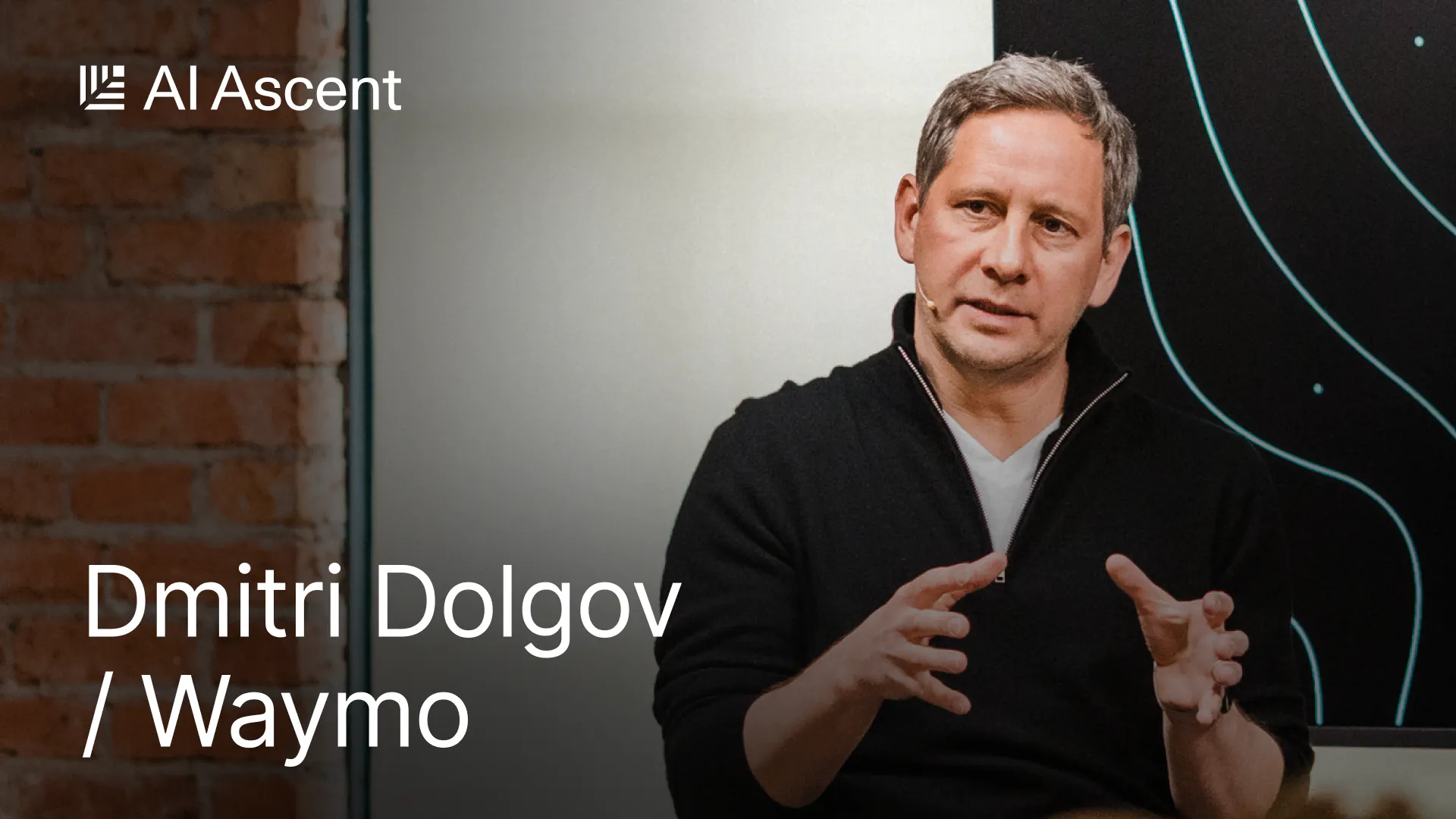
Waymo uses a foundation model to create specialized, high-capacity "teacher" models (Driver, Simulator, Critic) offline. These teachers then distill their knowledge into smaller, efficient "student" models that can run in real-time on the vehicle, balancing massive computational power with on-device constraints.
The transition from supervised learning (copying internet text) to reinforcement learning (rewarding a model for achieving a goal) marks a fundamental breakthrough. This method, used in Anthropic's Opus 3 model, allows AI to develop novel problem-solving capabilities beyond simple data emulation.

Initially criticized for forgoing expensive LIDAR, Tesla's vision-based self-driving system compelled it to solve the harder, more scalable problem of AI-based reasoning. This long-term bet on foundation models for driving is now converging with the direction competitors are also taking.

Instead of using traditional, rule-based simulators, Comma AI trains its driving agent inside a learned "world model." This generative model creates photorealistic, diverse driving scenarios and, crucially, responds accurately to the agent's simulated actions—a key requirement for effective robotics training.
A human driver's lesson from a mistake is isolated. In contrast, when one self-driving car makes an error and learns, the correction is instantly propagated to all other cars in the network. This collective learning creates an exponential improvement curve that individual humans cannot match.