Get your free personalized podcast brief
We scan new podcasts and send you the top 5 insights daily.
The traditional approach of stratifying Mantle Cell Lymphoma patients as "younger/fit" or "older/unfit" is becoming obsolete. As effective targeted therapies reduce reliance on intensive chemo and transplant, biologic markers like P53 status and KI-67 proliferation index are becoming the primary drivers of risk assessment and treatment selection.

Related Insights
For limited-stage DLBCL, treatment decisions have evolved beyond a simple bulky vs. non-bulky assessment. The NCCN now uses the stage-modified IPI (SMIPI) score. A low score allows for abbreviated chemotherapy, while a high score mandates a more aggressive, advanced-stage treatment pathway regardless of tumor bulk.

The clinical decision for newly diagnosed, transplant-ineligible myeloma patients has fundamentally shifted. Instead of determining who is eligible for a quadruplet regimen, the primary question for clinicians is now identifying the few patients who are not fit enough for this new standard of care.

Experts view R-mini-CHOP, the standard for older/unfit DLBCL patients, as a poor benchmark that urgently needs to be replaced. Promising chemo-free or chemo-light regimens, like the R-Polo-Glofitamab combination, are seen as the future, aiming to improve outcomes in this vulnerable population without harsh toxicities.

Modern therapies have dramatically improved survival for high-risk CLL patients. However, this group paradoxically represents the largest unmet need, as they are the most likely to develop resistance to the main drug classes over decades, driving research into novel mechanisms like degraders and non-covalent inhibitors.
While quizartinib's benefit is less pronounced in AML patients over 60, a specific genomic signature—the co-occurrence of FLT3-ITD, NPM1, and DNMT3A mutations—identifies a subset of older patients who derive a significant survival benefit, challenging age-based treatment decisions.
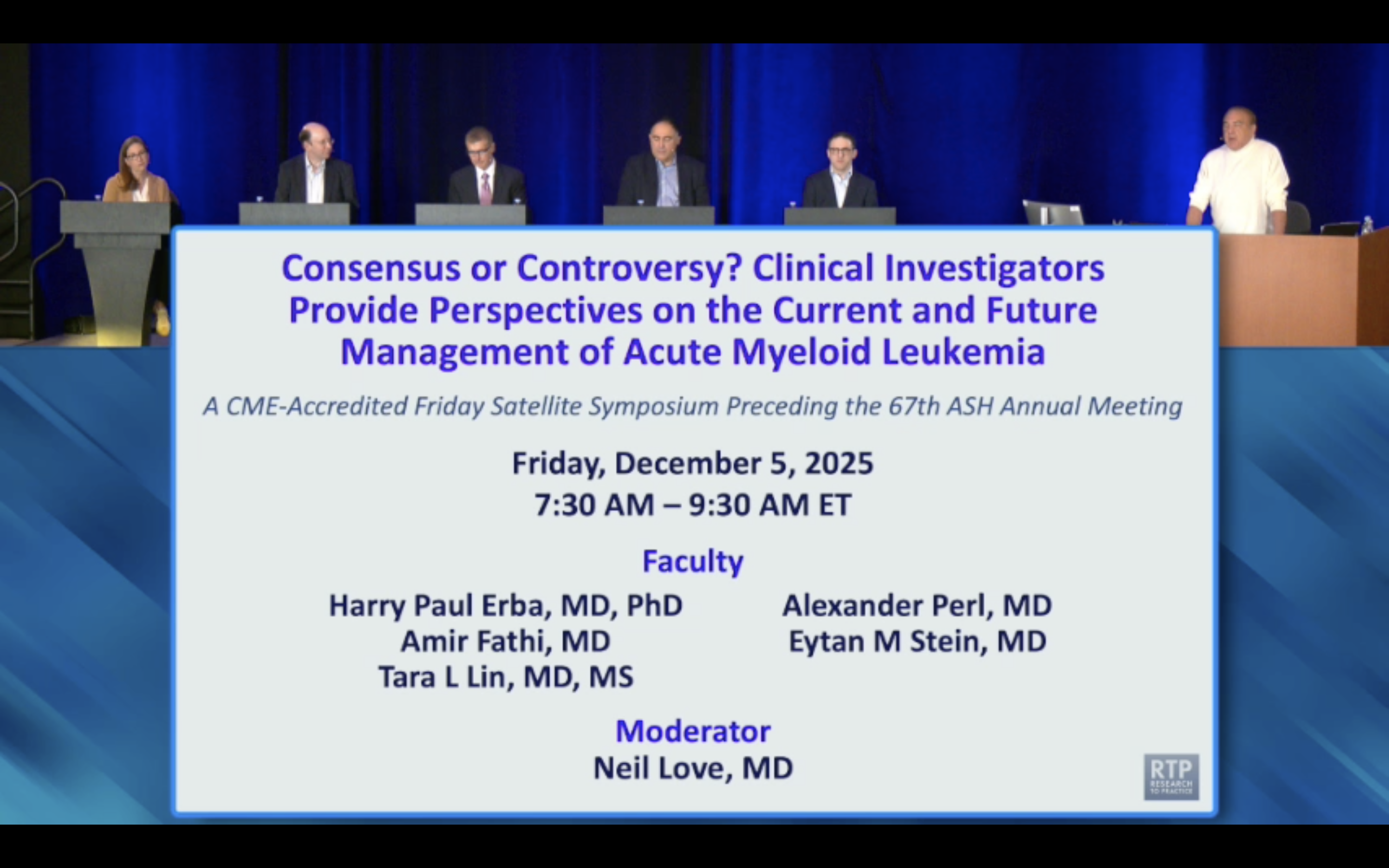
Traditional age cutoffs for AML therapy are becoming obsolete. A comprehensive fitness assessment, not just chronological age, should guide treatment, as some guidelines now classify patients as young as 55 as "older adults," a surprising shift for many clinicians.
The landmark TRIANGLE trial has redefined frontline therapy for younger, fit mantle cell lymphoma patients. Adding a BTK inhibitor to induction and maintenance provides outcomes superimposable to those including an autologous stem cell transplant. This allows clinicians to omit the transplant, sparing patients significant toxicity without compromising efficacy.
In the era of potent targeted therapies for Philadelphia chromosome-positive B-ALL, the most critical factor for deciding on a consolidative allogeneic stem cell transplant is persistent minimal residual disease (MRD). This response-based metric has become more important than baseline mutational status for upfront risk stratification and treatment planning.
TP53-mutated AML carries an extremely poor prognosis, significantly worse than other adverse-risk subtypes. When TP53 patients are excluded from analyses, the survival gap between the remaining adverse-risk and intermediate-risk patients narrows considerably, clarifying risk stratification.
The ongoing Alliance ASPIRE trial is one of the first to use tumor biology, specifically alterations in suppressor genes like P10, P53, and RB1, as a primary stratification factor. This marks a significant move away from relying on imaging-based volume criteria (high vs. low) to determine prognosis and predict who may benefit from chemotherapy.
