Get your free personalized podcast brief
We scan new podcasts and send you the top 5 insights daily.
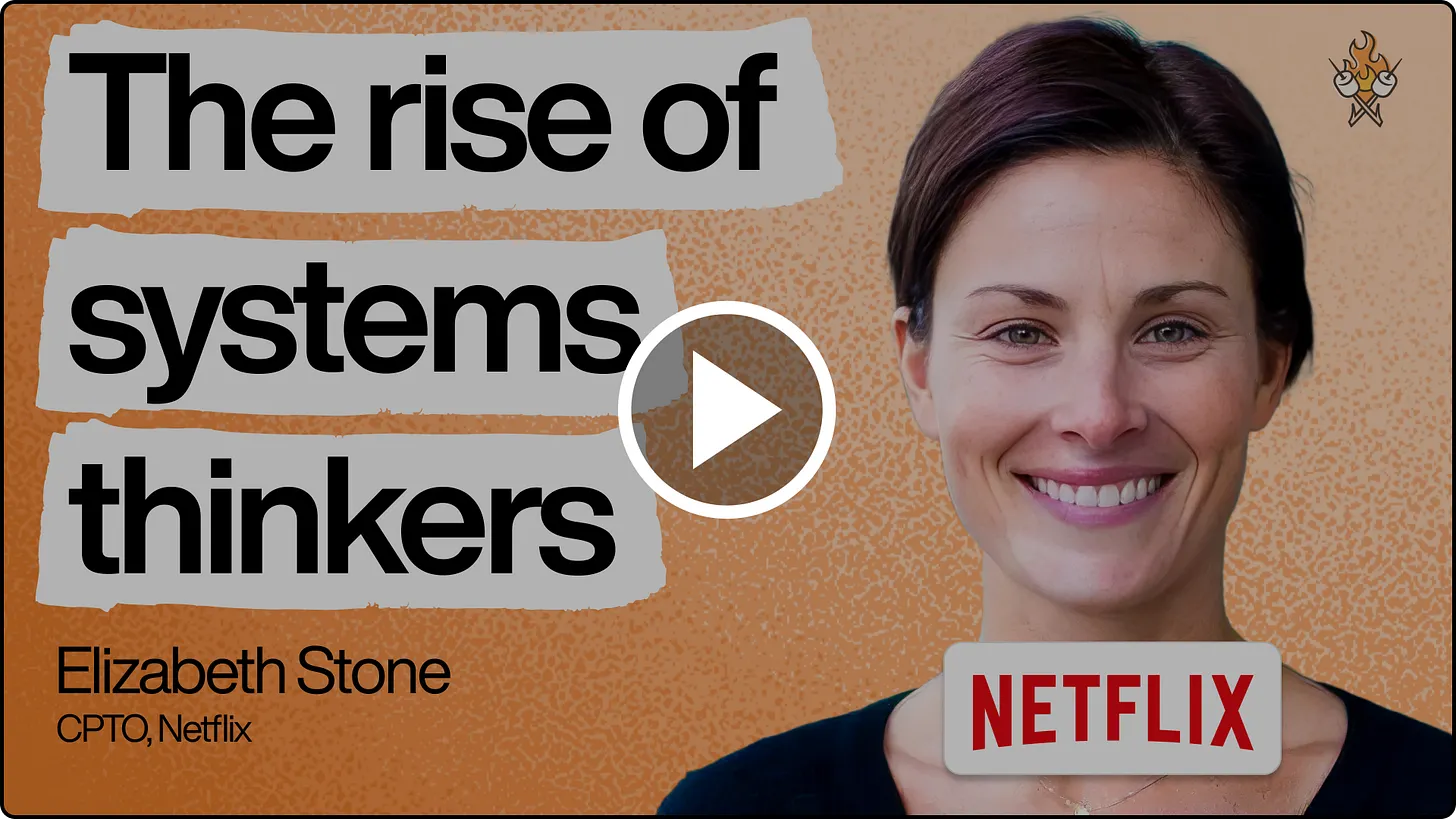
To manage risks and unlock the speed of AI, Netflix is shifting hiring toward "systems thinkers." These individuals create common infrastructure, "paved paths," and design systems. This scaffolding enables many teams to build quickly and safely without relying on tribal knowledge, which becomes critical as AI agents proliferate.
Related Insights
Previously, teams needed specialists ('ammunition') to execute tasks. With AI copilots, a single, high-agency individual ('barrel') can now build entire products. This changes hiring strategy to prioritize resourceful generalists who can leverage AI to knock down doors and get things done independently.

Theoretical knowledge is now just a prerequisite, not the key to getting hired in AI. Companies demand candidates who can demonstrate practical, day-one skills in building, deploying, and maintaining real, scalable AI systems. The ability to build is the new currency.
As AI handles routine coding, the most valuable engineers are either "dreamers" with strong product sense who can own features end-to-end, or deep subject matter experts who can verify and handle the complex, trust-critical parts of the system where human verification is still essential.

In an AI-first world, an engineer's role shifts from writing feature code to building leverage. They become akin to staff engineers for AI agents, creating the systems, documentation, and automated tests (the "harness") that empower AI to produce high-quality work autonomously.

Netflix's CPTO observes that the value of narrow, deep specialization is declining. While still crucial for certain niche technologies, the preference is shifting toward adaptable generalists who can work across functions and stacks. The modern mindset is "I can learn that quickly" rather than sticking to one expertise.
When building core AI technology, prioritize hiring 'AI-native' recent graduates over seasoned veterans. These individuals often possess a fearless execution mindset and a foundational understanding of new paradigms that is critical for building from the ground up, countering the traditional wisdom of hiring for experience.

With AI handling much of the coding, the most valuable engineers are no longer just prolific coders. Companies now prioritize platform engineers who can make deep architectural choices and product engineers who can embed with customers to excel at requirements gathering, which becomes the new bottleneck.

As AI assistants lower the technical barrier for research, the bottleneck for progress is shifting from coding ("iterators") to management and scaling ("amplifiers"). People skills, management ability, and networking are becoming the most critical and in-demand traits for AI safety organizations.

Beyond coding and prototyping, a major AI unlock for Netflix is synthesizing its vast institutional knowledge. AI tools can instantly analyze decades of experiments and research, allowing any employee to draw insights that previously required finding a long-tenured expert, thus accelerating decision-making.
Instead of defining level-specific AI skills in career ladders, Netflix fosters an organization-wide "aspiration for AI fluency." This broad expectation encourages everyone, regardless of role, to develop an experimentation mindset and good judgment on when to apply AI, a scalable approach in a rapidly changing field.