Get your free personalized podcast brief
We scan new podcasts and send you the top 5 insights daily.
The primary bottleneck for many users isn't a model's raw intelligence but the user's ability to provide sufficient context. The next paradigm shift will be AIs that can autonomously enter a new environment (like a Slack channel), gather context, and figure out how to be useful, dramatically lowering the barrier to value.

Related Insights
Current LLMs are intelligent enough for many tasks but fail because they lack access to complete context—emails, Slack messages, past data. The next step is building products that ingest this real-world context, making it available for the model to act upon.
![[State of RL/Reasoning] IMO/IOI Gold, OpenAI o3/GPT-5, and Cursor Composer — Ashvin Nair, Cursor thumbnail](https://assets.flightcast.com/V2Uploads/nvaja2542wefzb8rjg5f519m/01K4D8FB4MNA071BM5ZDSMH34N/square.jpg)
As models become more powerful, the primary challenge shifts from improving capabilities to creating better ways for humans to specify what they want. Natural language is too ambiguous and code too rigid, creating a need for a new abstraction layer for intent.

The next step for agents is self-awareness: understanding the specifics of their "harness"—the tools, APIs, and constraints of their environment. This awareness is a prerequisite for more advanced behaviors like identifying knowledge gaps and eventually modifying their own system prompts.
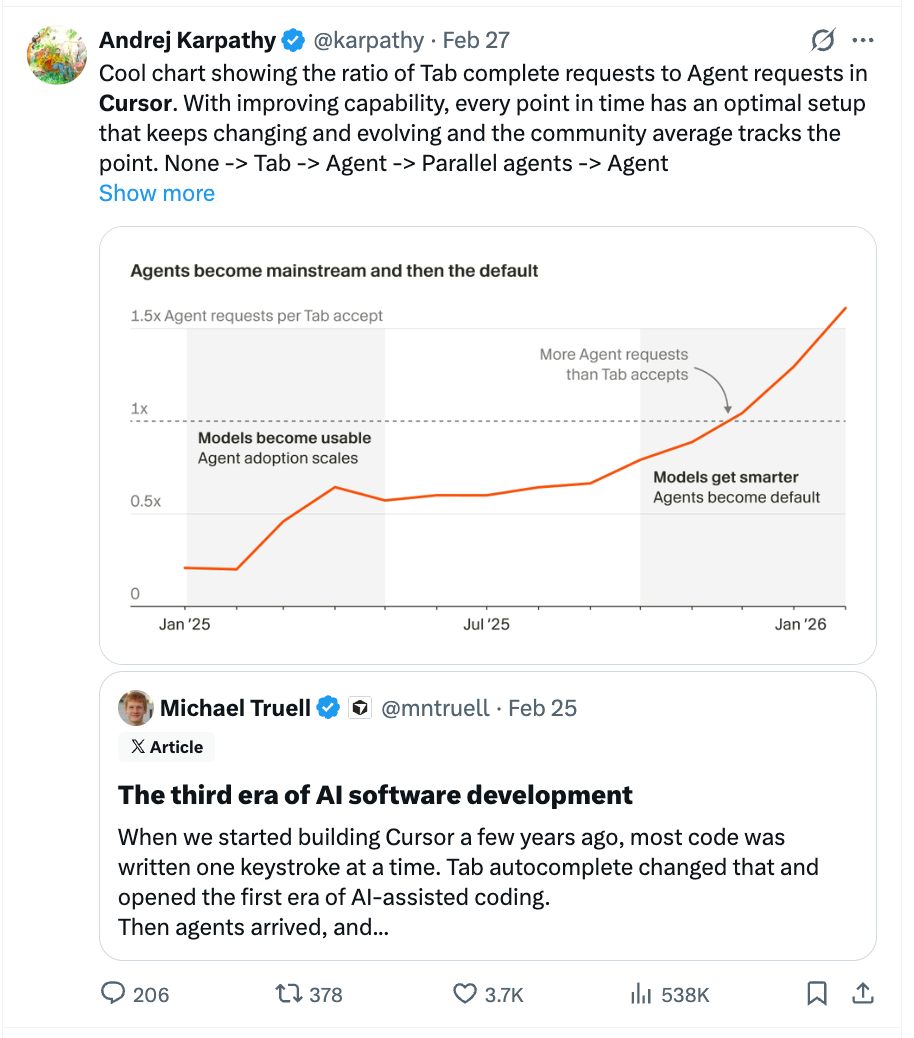
Tools like ChatGPT are AI models you converse with, requiring constant input for each step. Autonomous agents like OpenClaw represent a fundamental shift where users delegate outcomes, not just tasks. The AI works autonomously to manage calendars, send emails, or check-in for flights without step-by-step human guidance.

While language models are becoming incrementally better at conversation, the next significant leap in AI is defined by multimodal understanding and the ability to perform tasks, such as navigating websites. This shift from conversational prowess to agentic action marks the new frontier for a true "step change" in AI capabilities.

The early focus on crafting the perfect prompt is obsolete. Sophisticated AI interaction is now about 'context engineering': architecting the entire environment by providing models with the right tools, data, and retrieval mechanisms to guide their reasoning process effectively.

Instead of just expanding context windows, the next architectural shift is toward models that learn to manage their own context. Inspired by Recursive Language Models (RLMs), these agents will actively retrieve, transform, and store information in a persistent state, enabling more effective long-horizon reasoning.

Elias Torres argues that the current AI paradigm, which focuses on tools that assist humans (e.g., summarizers, drafters), is fundamentally limited. He believes true value is unlocked when you can instruct an AI to perform a task *infinitely* on its own, without requiring a human to type into a chat box for every action.

The perceived limits of today's AI are not inherent to the models themselves but to our failure to build the right "agentic scaffold" around them. There's a "model capability overhang" where much more potential can be unlocked with better prompting, context engineering, and tool integrations.

Web-based AIs like ChatGPT are limited because users must constantly re-explain project context. The real bottleneck to unlocking an LLM's full potential isn't the model, but the inefficiency of providing it with the right information at the right time.
